A Century in Motion — Part 10: The 1960s, Between Flight from the Past and Unease About the Future
11 April 2026 2 min read 5 images
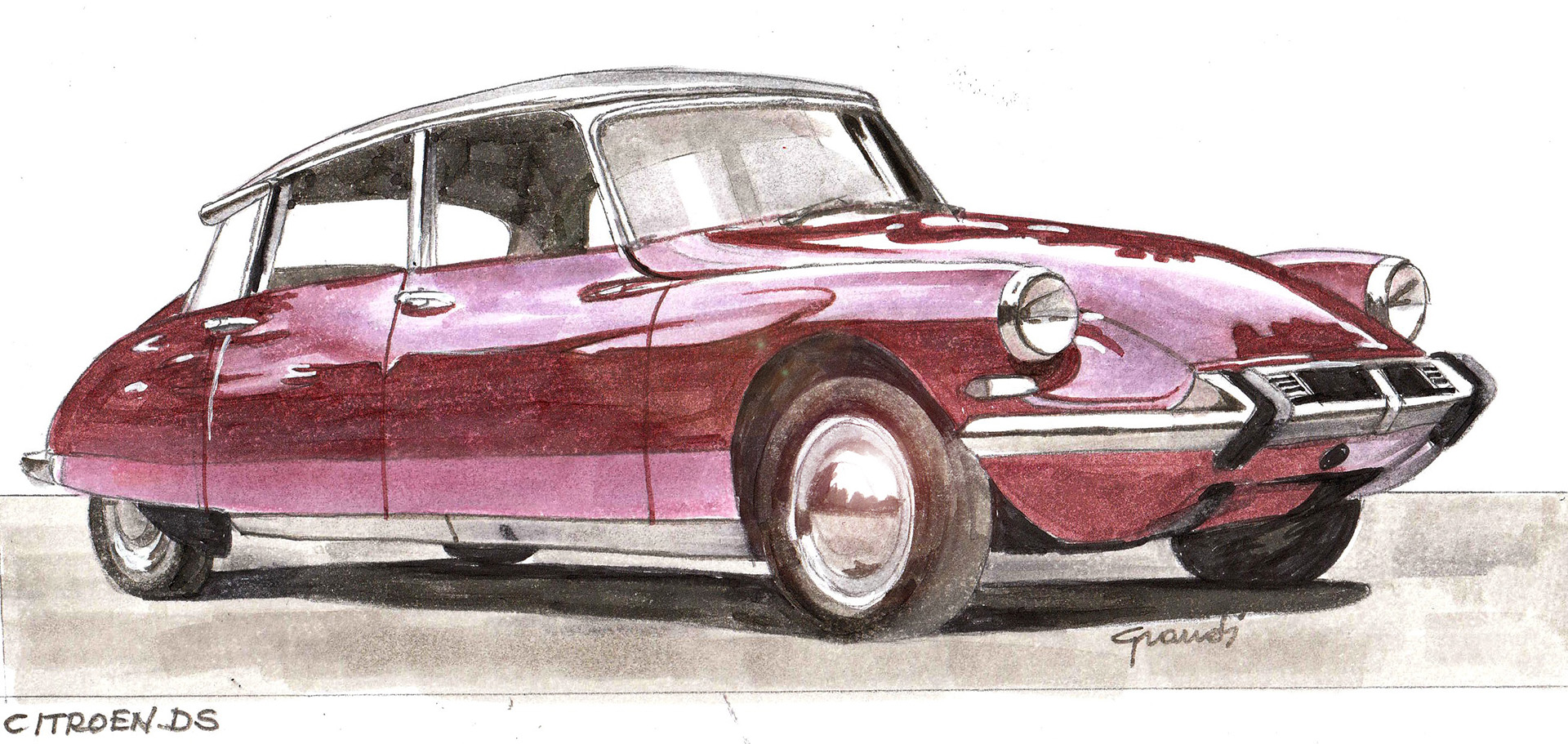
Photo credit: Massimo Grandi, Mattel
At the Paris Motor Show of 1955 — on the 6th of October, precisely — there appeared an automobile so innovative, so unlike anything that had come before, that it seemed like a spacecraft that had landed in a medieval village. Its revolutionary force derived from a crucial fact: it was a real production car, not one of the many dream cars inspired by the jet aircraft of the era. It made clear that these were, truly, the years of aesthetic visionary thinking aimed at the future. The Citroën DS, with its thousand innovations, was the most powerful signal of all. Architecture confirmed it, with projects of grand ambition such as Kenzo Tange’s Tokyo Bay Plan, just as the rigorous imagination of the great Northern European masters — Finn Juhl, Arne Jacobsen, Alvar Aalto, Eero Saarinen — confirmed it in the world of furniture and design.

These were years in which the desire to escape from the past expressed itself through art — in the monochromes of Yves Klein, which sought to represent the conquest of the absolute through pure colour — and through cinema, with the dreams of Federico Fellini, who imagined a “dolce vita” built around the magnificent and elegant Anita Ekberg, submerged, fully dressed, in the joyful rushing water of the Trevi Fountain.

In those same years, alongside the dreamed-of small car for everyone — the little Fiat 500 — there stood magnificent jewels such as the Ferrari 250 GT Short Wheelbase and the Maserati 3500 GT.
This energy concealed, beneath its surface, a way of defending oneself against the looming Cold War: a world divided into two blocs, both armed with nuclear weapons, was at once a threat and a strange kind of reassurance. Facing a Soviet leader like Nikita Khrushchev — who became famous for removing his shoe during a heated confrontation with the Americans and slamming it violently on the table — stood a charismatic leader like John Kennedy, who cultivated his own image with all the techniques of a Hollywood star.

Perhaps it was precisely the fears of the Cold War that pushed American manufacturers towards “compact” models, progressively abandoning the showy, fuel-thirsty cars of the 1950s. Symbol of this new direction — which the market accepted very reluctantly — was a sort of American Volkswagen Beetle: the Chevrolet Corvair, fitted with a rear-mounted, air-cooled six-cylinder engine. An attractive car, but disastrously deficient in road-holding. A demonstration of how America and Europe were, and remain, far too different ever to serve as an example for one another.

It is easier to impose a taste, a style — and export it. That is exactly what happened with the birth of Barbie: a powerful engine of dreams for little girls on every continent, with fashion collections and accessories perfectly aligned with the sensibilities of the era and the aspirations of a generation waiting to be fulfilled.