Photo credit: Bonhams, Gooding, RM Sotheby’s
In the 1950s, England interpreted the concept of the open sports car by bringing together a simplicity that was at times almost spartan, a severity in the driving position and in the relationship with the steering wheel and gearchange that belonged to a true racing car, and a hood arrangement that seemed designed to discourage anyone from using it. If you want a British sports car, whatever the weather, enjoy it pure and uncompromising. All of this at costs that were not prohibitive, giving many the chance to feel like daring drivers – not so much on a circuit, but on the narrow, winding roads drawn precisely for compact, responsive cars stripped of everything not strictly necessary.
The result was a generation of sports cars capable of offering authentic sensations to a far wider public than that of the great luxury machines. Jaguar and Aston Martin represented the more refined and prestigious face of British industry, but the myth of the British roadster was born above all thanks to marques such as MG, Triumph, Austin-Healey, Morgan, Lotus, AC, and Sunbeam, which brought essential, always recognisable automobiles to the road – defined by character and driving pleasure.
Each interpreted this philosophy differently. Morgan remained tied to the most archaic craft construction, Lotus eliminated every superfluous element to shed weight, Triumph relied on a rough-hewn robustness, MG on the simplicity of tradition, Austin-Healey united elegance and performance, while AC and TVR explored more extreme and unconventional solutions. More than seventy years on, these roadsters continue to represent one of the purest expressions of the sporting automobile, because they recall an era when having fun required not hundreds of horsepower, but a light car, an open road, and the willingness to carry on even when the rain began to fall.
Presented in 1948, the Jaguar XK120 combined a line destined to become a stylistic reference with exceptional performance for the era – so much so that at its debut it was considered the fastest production car in the world.
The Morgan Plus 4 carried forward a craft tradition built on simple solutions, hand workmanship, and an ash-wood frame, maintaining over time an identity that has remained almost entirely unchanged to this day.
Light, balanced, and elegant, the AC Ace was born as a refined British sports car and became the foundation on which Carroll Shelby built the Cobra, replacing its running gear with a powerful American V8. It was no longer English, but it became legendary.
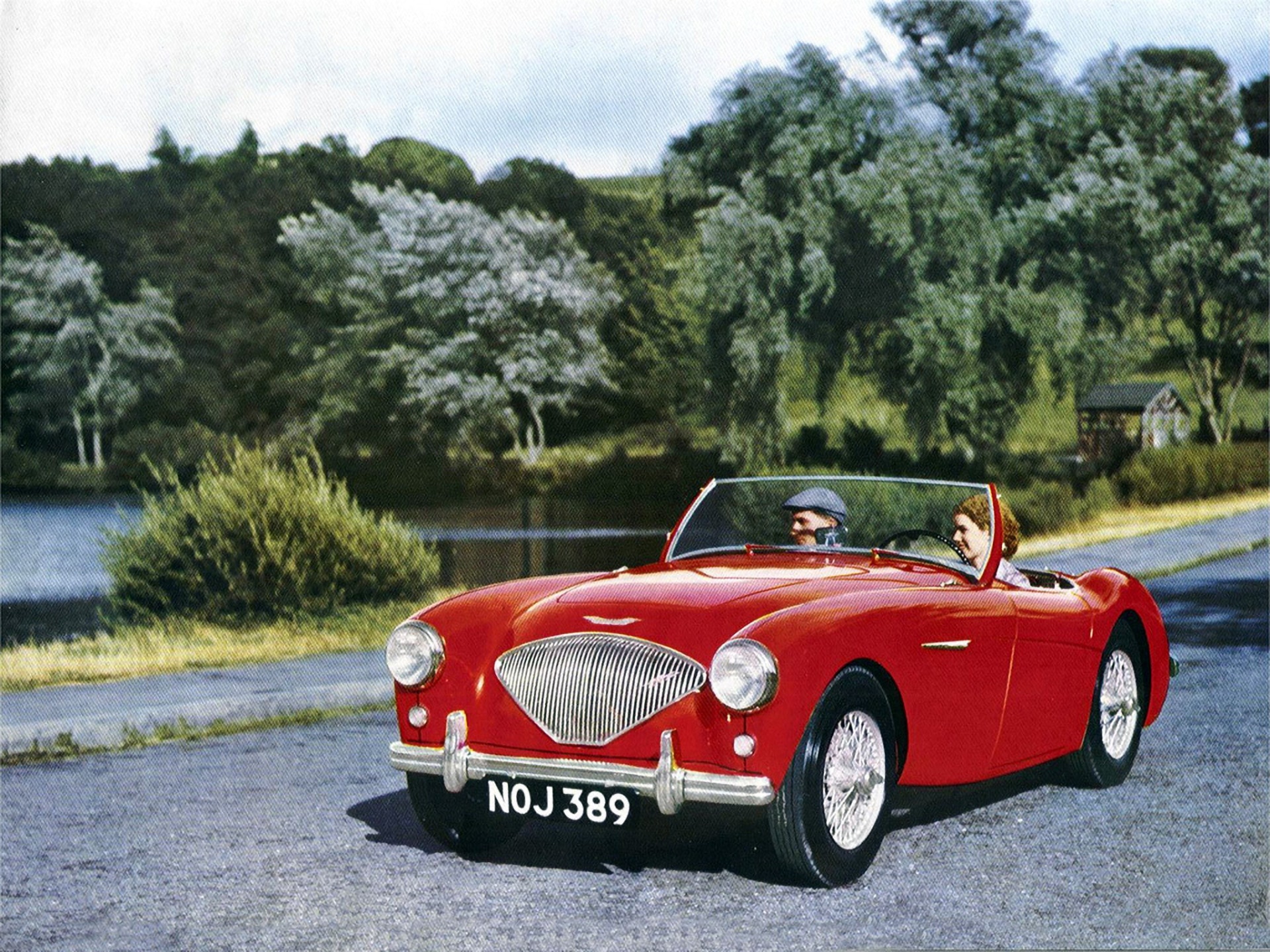
The Austin-Healey 100 quickly won over the public with its clean and genuinely compelling lines, its lively performance, and a price that made class-conscious sporting driving accessible to those who could not afford a Jaguar or an Aston Martin.
Compact, robust, and free of unnecessary refinements, the Triumph TR2 was defined by a distinctive and original style – doors cut to their minimum by a characteristic scalloped recess – and a kart-like driving experience of tremendous fun. Utterly solid, it also possessed the resilience and character needed to tackle rallies and races.
With a more modern and aerodynamic body than the MG models that preceded it, the MG A became one of the most widely sold British roadsters in the world and contributed decisively to the success of British sports cars in the United States.
With the Seven, Colin Chapman applied to the road the same philosophy he used in competition, eliminating weight and superfluous components until he arrived at one of the most essential, responsive, and involving cars ever made. In essence, a kind of road-going single-seater.
More comfortable and less extreme than other British roadsters, the Sunbeam Alpine offered a sound balance bet