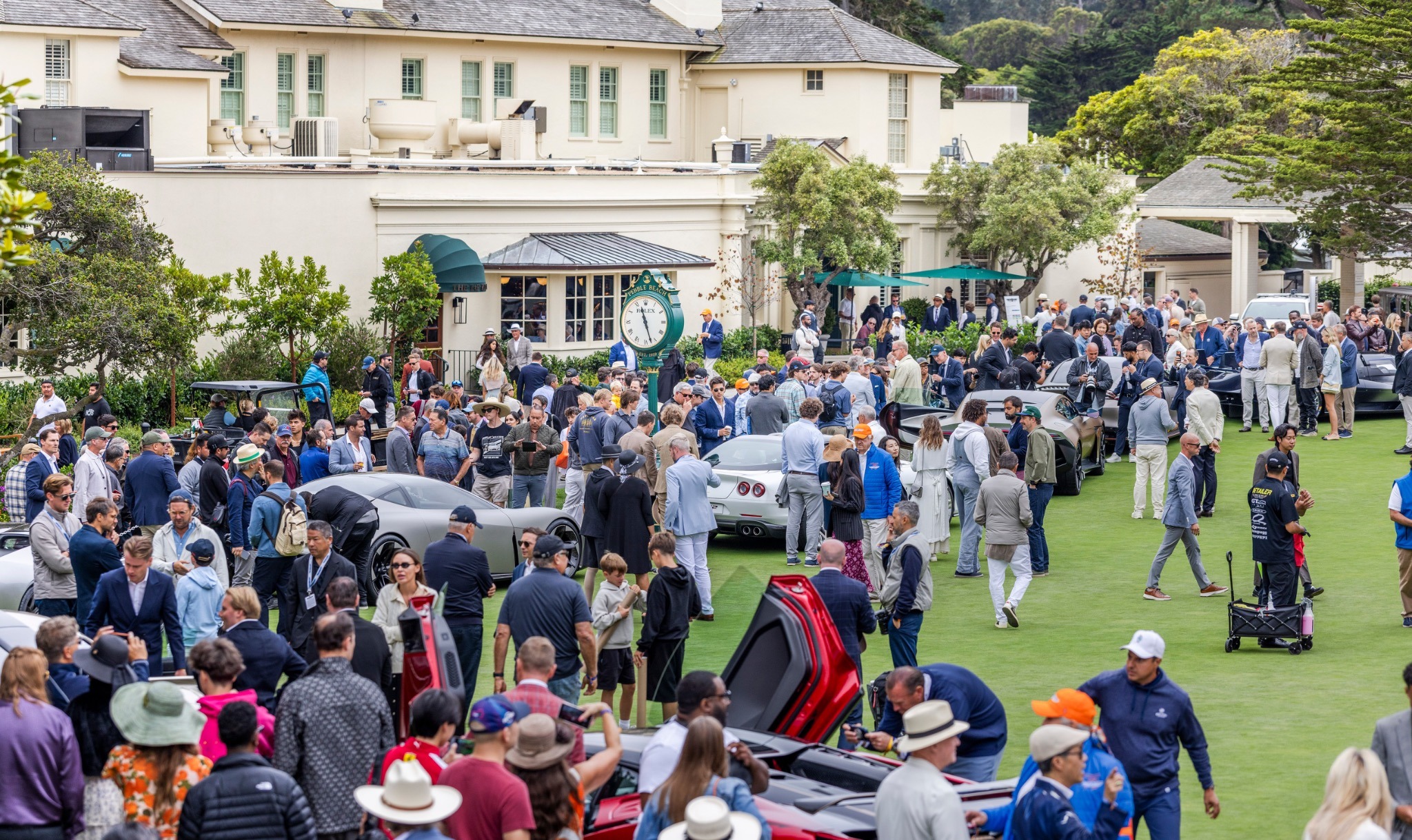
Photo credit: Pebble Beach Concours d’Elegance, Rolex
Will the Manufacturers Know How to Learn from the Message That Arrived from Monterey?
Gold has traditionally been the universally recognised safe-haven asset. After the Monterey auctions – and we can say this without fear of contradiction – and after the first part of 2026 in Europe as well, it seems that collectible cars, contemporary or classic, are mounting a challenge to the crown of the precious metal. The thought that five auctions, over three days, turned over something in the region of 700 million dollars gives one pause.
It would be wrong, however, to read the strength of the 2026 market in purely speculative terms. There is no market without its ups and downs, and the car market carries variables that set it apart from all others: the era of each car, its characteristics, and the shifting desires for this model or that – driven by fashions destined to change over time – continually alter its equilibria. That every market brings its own uncertainties is well understood. As the brilliant Giovanni Agnelli once said, when he was president of the Fiat Group, on the subject of investments and risk: "investing in wine has one advantage – if the market turns bad, you can always drink it."
Starting from there, we can draw one observation from the results of the Monterey Car Week: that if this car or that one you have bought loses value, you can always love it and drive it.
That is not merely a riff on Agnelli’s line – in fact, it is probably the very heart of this moment of enthusiasm, which seems to push back against a world full of uncertainty. Why? Simply because we are living through a tension between what the market offers us today and the deep feeling we hold for the car, its history, and its values.
What the market offers us today are cars that function perfectly, loaded with features, often leased rather than owned – and therefore felt to be not quite ours – carrying unknown marques or marques without history. Strip away the magnificent stories of technology, sport, and personal memory bound up in names such as Mercedes-Benz, Ferrari, Porsche, Ford, and a few others, and buying a car means buying not the emotion of what its badge represents, but an object technically capable of doing what we need. Perfect – but without a soul.
Looking at which cars made the greatest mark at Pebble Beach and across the Monterey Week as a whole, one finds cars with a soul and with a great heart. It is precisely those qualities – intangible yet profound – that hold the key to understanding why cars that have made history, or that are preparing to continue it, sell the way they do.
It is not for us at Roarington to ask why so many marques today choose a bland, functional anonymity. It appears they have decided to build their future on sand. What matters to us is the true culture of the automobile – born of men and women who set out to build cars capable of stirring emotion and finding a place in the heart.
And the market? No cause for alarm. Whatever the variations in price, one thing is certain: the value of cars with a soul and a history will endure – and the very banality of the current landscape will, in the end, only make them more precious.