Don’t Dream It. Be Part of It - We are hiring!

View open positions

Kustom Cars: 70 Years Before the One-Offs

  • 15 August 2025
  • 1 min read
  • 3 images
Kustom Cars: 70 Years Before the One-Offs image

Photo credit: Ed Roth, George Barris, Mecum

If hot rods were born as individual expression – unique objects through which to project the self – kustom cars followed a different path. They did not abandon the creativity that had animated the garages of California, but they shifted perspective entirely. The goal was no longer to race in pursuit of performance, but to create cars capable of astonishing before the engine was ever started. It is no coincidence that the specialists in these transformations were few and well known: even today the names of George Barris and Ed Roth bring enthusiasts to attention.
Kustom Cars - 1 More than a car, the Golden Sahara II was a manifesto of American style in the 1950s. Displayed alongside a coordinated motorboat, it embodied the dream of spectacular luxury in which design, speed, and leisure fused into a single vision.
The "C" of custom was replaced by a "K" to make unmistakably clear that those curious cars were the symbol of a new culture – a different way of interpreting the automobile and, more broadly, of changing the relationship between a person and an object. A unique object, entirely your own. To customise was to distance oneself from mass production, to refuse the idea that all cars should be identical, and to transform a means of transport into an extension of one’s own personality. Precisely what today’s one-offs seek to achieve.

Here too, as with hot rods, postwar California proved the ideal ground. After years of privation, the desire for self-expression found in the automobile an immediate and universal language. Bodies were lowered, rooflines chopped to alter windows and windscreens in ways that transformed the appearance of whatever donor model had served as the starting point. Lines were made more fluid, chrome was reshaped, and paint abandoned conventional colours in favour of brilliant hues and unexpected combinations.
Kustom Cars - 2 The Mysterion by Ed "Big Daddy" Roth, unveiled in 1963, pushed the language of American show cars to the extreme: twin Ford engines, an asymmetric body, a transparent dome, and a blinding gold livery.
Nothing was left to chance. Every intervention was born from the builder’s imagination. Kustom cars did not follow a trend – they interpreted the taste of the client. As with a work of art, each example told a different story. Two cars built from the same donor model could assume entirely opposite personalities, because what mattered was not the starting point but the vision of the person doing the transforming.

The creativity of figures such as George Barris and Ed Roth – and many others besides – eventually alarmed General Motors, Ford, and Chrysler themselves, who made attempts to bring them in as consultants at their design studios or even to hire them outright at considerable expense. It came to nothing. Those who built kustom cars wanted, and needed, to be completely free in their choices – something a manufacturer is not capable of allowing.

It is precisely this singularity that makes the phenomenon difficult to place within the traditional categories of automotive history. Kustom cars do not simply represent a chapter in aesthetic customisation. They are proof that an industrial product can become an object of artistic expression and of pure pleasure for whoever owns it.

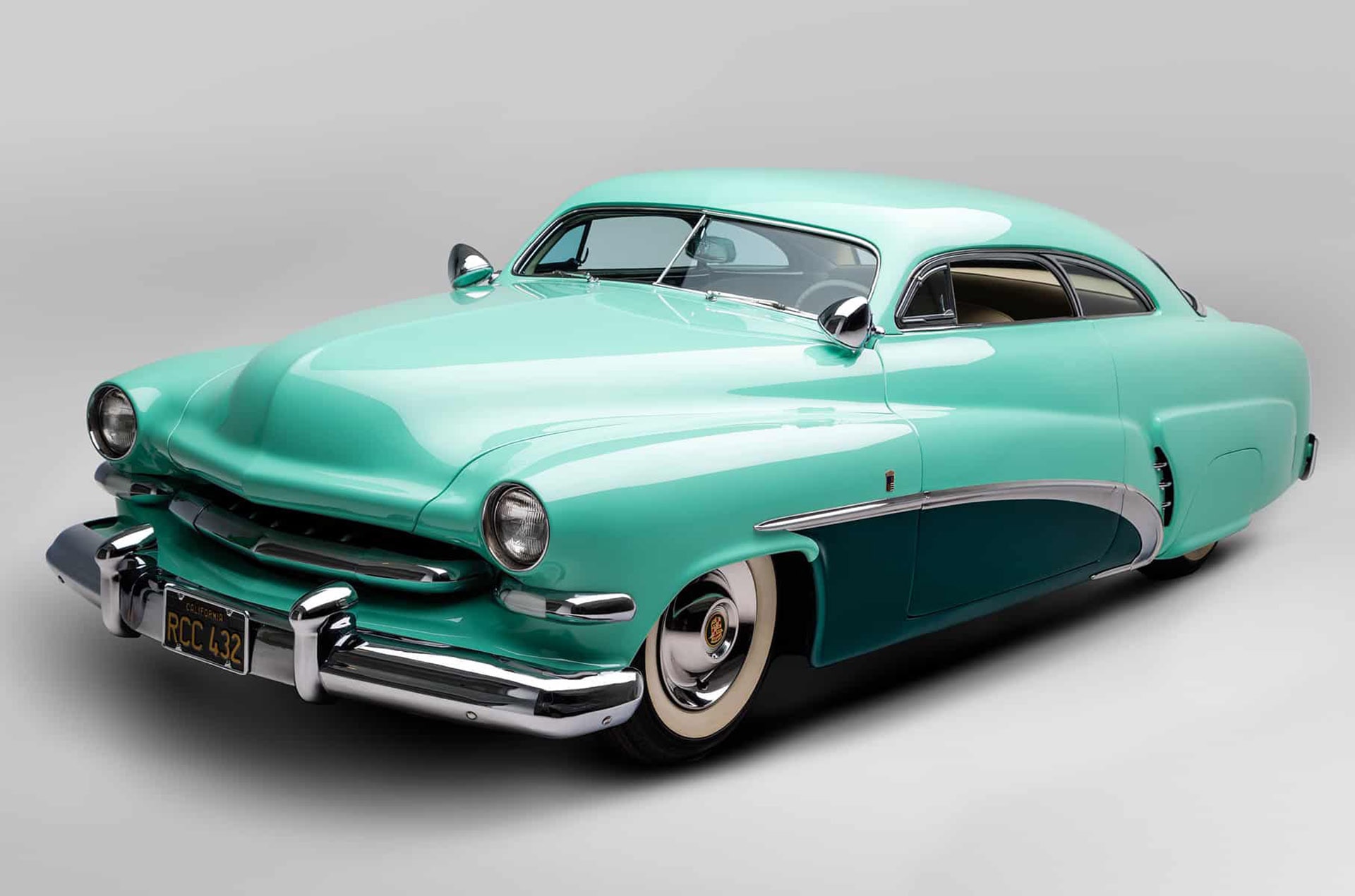
The most celebrated kustoms command serious prices at auction: the famous Hirohata Merc by George Barris, which went under the hammer at Mecum Kissimmee in Florida in 2023, exceeded two million dollars.
Kustom Cars - 3 The 1951 Hirohata Merc, built by Sam and George Barris in 1952, is considered the most famous custom car in history. It remains to this day the benchmark for elegance, proportion, and style in the world of personalised Mercury builds.