Photo credit: Wheelsage
1950 was the year of birth of the Formula 1 World Drivers’ Championship, contested with single-seater cars powered by either supercharged 1500cc engines or naturally aspirated 4500cc units. The Constructors’ Championship — or Marques Championship, as it was then called — was run separately, with two-seater Sports cars.
The single-seaters of those years were conceived entirely according to pre-war tradition: engine at the front, drive to the rear wheels. Only Auto Union had dared to experiment with a rear-engined single-seater — and had succeeded, it must be said, with remarkable conviction. The idea of revisiting that concept had come from Ferdinand Porsche, financed by the Italian industrialist Piero Dusio of Cisitalia, who in 1949 designed a revolutionary Formula 1 car with the engine behind the driver. The financial burden, however, proved overwhelming, and the car never turned a wheel in anger. Today it rests in Stuttgart, in the Porsche Museum — a beautiful ghost.
Against that backdrop, the 1950 season opened in a manner entirely faithful to the old order: the small supercharged Alfa Romeo 1500s prevailed over the innovative Ferrari V12 of 4500cc — a car that would come into its own only when the regulations changed to favour it. But the seeds of technical revolution had already been sown. In 1956, at the French Grand Prix in Reims, a rear-engined Bugatti appeared on the grid — designed by the Italian engineer Gioachino Colombo, the very man who had given Ferrari its first V12. Driven by Maurice Trintignant, it completed only a few laps before retiring. With it went the dream of a Bugatti revival, through a return to racing, broken on the altar of mechanical frailty — and perhaps on the deeper absence of the great Ettore himself.
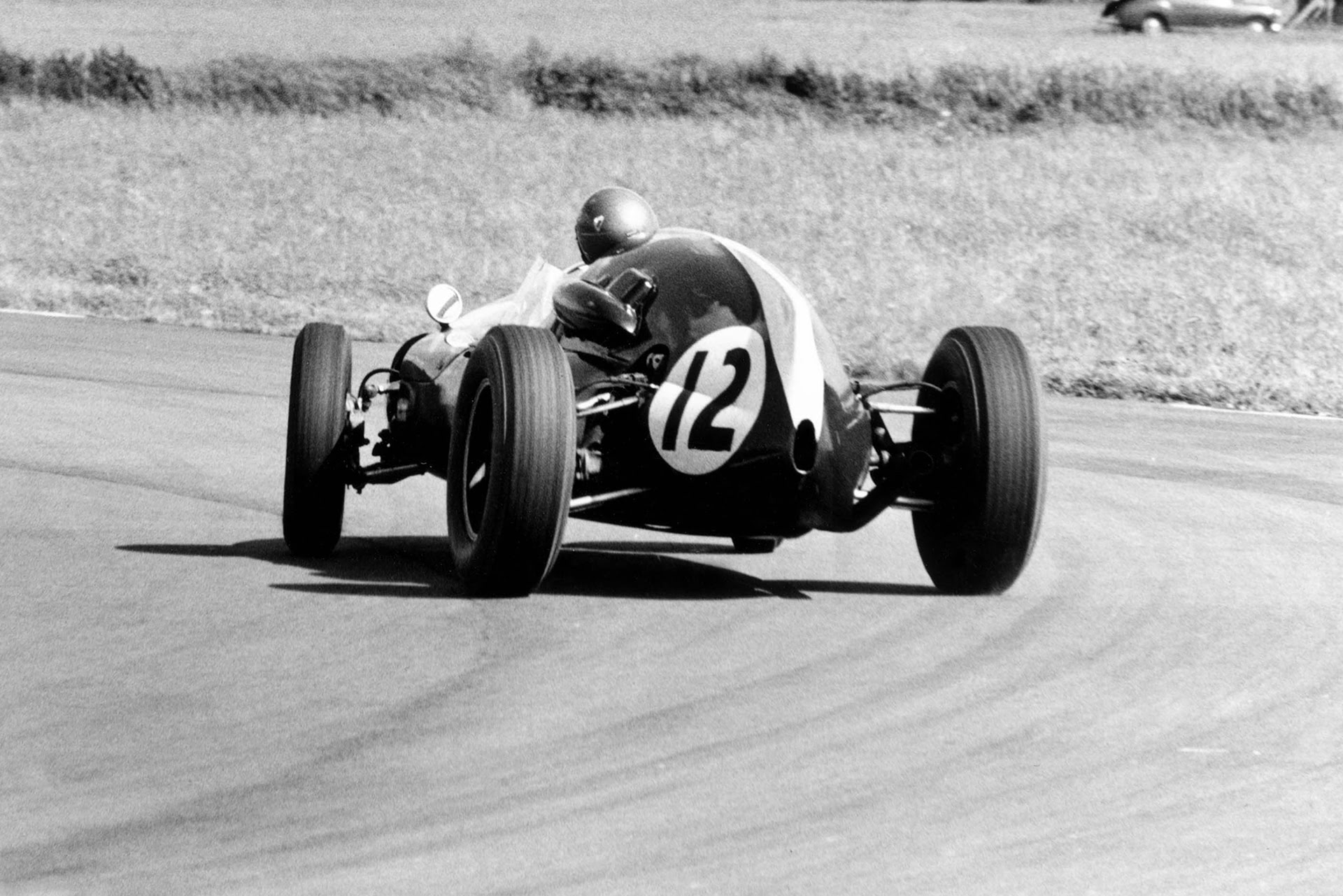
And so it fell to the English to play the ace of the rear engine in Formula 1. John Cooper had accumulated precious experience with his small Norton-engined Formula 3 single-seaters — nimble, simple, light, and wonderfully driveable machines. He decided to take that philosophy to the top. In 1957, at Monaco, Jack Brabham lined up on the grid with the little T43 Climax and finished sixth. What looked, to many, like a quixotic experiment revealed itself almost immediately as something far more serious: better weight distribution, the elimination of the heavy and cumbersome transmission shaft, superior traction, lower rotational inertia through the corners. The car, smaller and lighter than its rivals, also offered the gift of improved braking efficiency — not an insignificant thing in those years of long, fast circuits. In 1958, with Stirling Moss at the wheel, a Cooper Formula 1 won its first Grand Prix. In 1959 and 1960, Jack Brabham, the pillar of the Cooper Car Company, became World Champion.
Every team followed, with remarkable swiftness. Even Ferrari — the last to convert, out of the fierce resistance of Enzo Ferrari himself. He was a man of the land, Enzo, and he held firmly to the image of the ox pulling the cart — not pushing it. Yet even his will eventually bent: the first rear-engined Ferrari made its debut at the Monaco Grand Prix of 1960. The following year, 1961, Phil Hill became World Champion at the wheel of a rear-engined Ferrari. With the deepest respect, one imagines, for the oxen.
Signing up is free and gives you access to hundreds of articles and additional benefits. See what’s included in your free membership. See what's included in your free membership.
Already have an account? Log In