When Air Became Formula 1’s Greatest Ally. Wings and Downforce
28 March 2026 2 min read 5 images
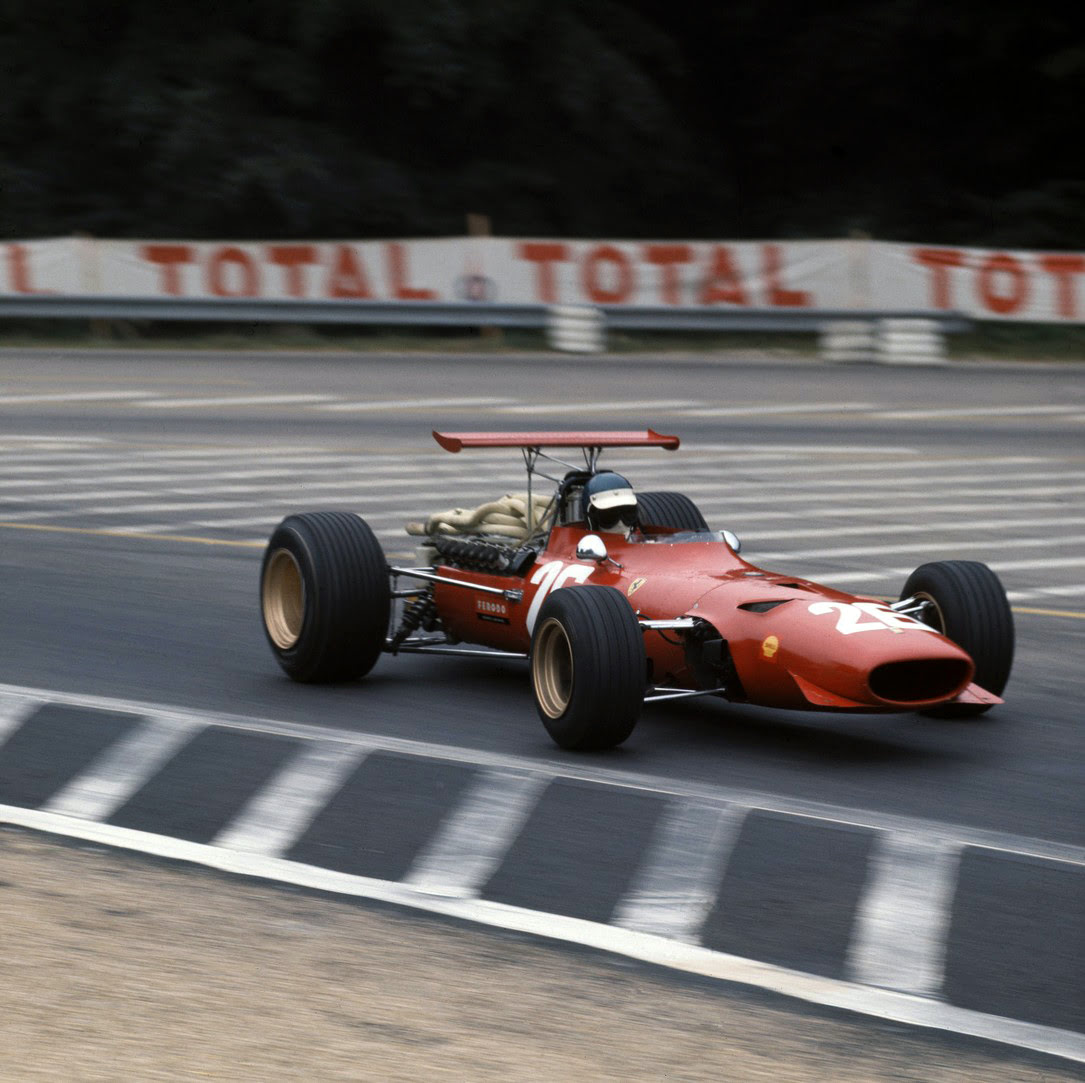
Photo credit: Ferrari, Lotus, Wheelsage
For decades, speed in Formula 1 had been a matter of raw power and streamlined bodywork — a relentless effort to reduce drag, culminating in the full aerodynamic enclosure of the Mercedes W196 Stromlinienwagen, deployed on the fastest circuits in 1954. The idea of using aerodynamics differently arrived from America, where the Chaparrals developed in the 1960s by Jim Hall employed something entirely new: a movable rear wing that generated aerodynamic load, pressing the car into the asphalt and multiplying its grip through the corners. It was a completely different way of thinking. Speed was no longer only about going fast in a straight line — it was about becoming fast in the curves above all else, about a car that could, as they said, “glue itself” to the road through vertical load.

This principle made its entrance into Formula 1 in the final years of the 1960s, and it found one of its first concrete expressions at the 1968 Belgian Grand Prix, on the circuit of Spa-Francorchamps. There, Scuderia Ferrari lined up the cars of Jacky Ickx and Chris Amon carrying a movable wing positioned in the central section of the car, close to the engine — almost midway between the cockpit and the rear axle. Behind that choice, at once simple and visionary, stood engineers Mauro Forghieri and Giacomo Caliri, among the very first to understand how an inverted aerofoil could generate a vertical force capable of dramatically improving adhesion.

Within the space of just a few races, what had initially appeared as an experimental curiosity transformed itself into a technical direction from which there was no turning back. It was Lotus, guided by Colin Chapman, who grasped the full depth of this revolution and turned it into a concrete competitive weapon. With the Lotus 49B — an evolution of the already formidable 49 — Lotus pursued the use of wings with systematic conviction. The experiments multiplied furiously across every team, until aerodynamic elements were connected directly to the suspension itself, so as to transfer downforce straight to the wheels and maximise its effect.
Register to unlock this article
Signing up is free and gives you access to hundreds of articles and additional benefits. See what’s included in your free membership. See what's included in your free membership.
Already have an account? Log In