Don’t Dream It. Be Part of It - We are hiring!

View open positions

The Mercedes-Benz Museum in Stuttgart Inaugurates "The Time Machine"

  • 04 April 2026
  • 2 min read
  • 6 images
The Mercedes-Benz Museum in Stuttgart Inaugurates "The Time Machine" image

Photo credit: Mercedes-Benz

What films and books have long imagined — the possibility of moving through time — is today, at the Mercedes-Benz Museum in Stuttgart, a reality. Within the span of a single hour, one can drive four authentic masterpieces that until now have stood magnificent and silent on the spectacular banked curve of the Silver Arrows — Races & Records gallery, traversing the entire history of the racing automobile. A genuine experience worthy of a time machine.
How? It is at once simpler and more thrilling than you might expect: all it takes is sitting behind the wheel of one of the Roarington simulators located in the Classic Insel at level 0 and driving, in sequence, the first four available cars belonging to entirely different eras. The simulator does not merely adapt to the specific characteristics of each Digital Twin of the original cars — it allows you to feel their real behaviour, returning authentic sensations of acceleration, braking, weight transfer, and steering response.
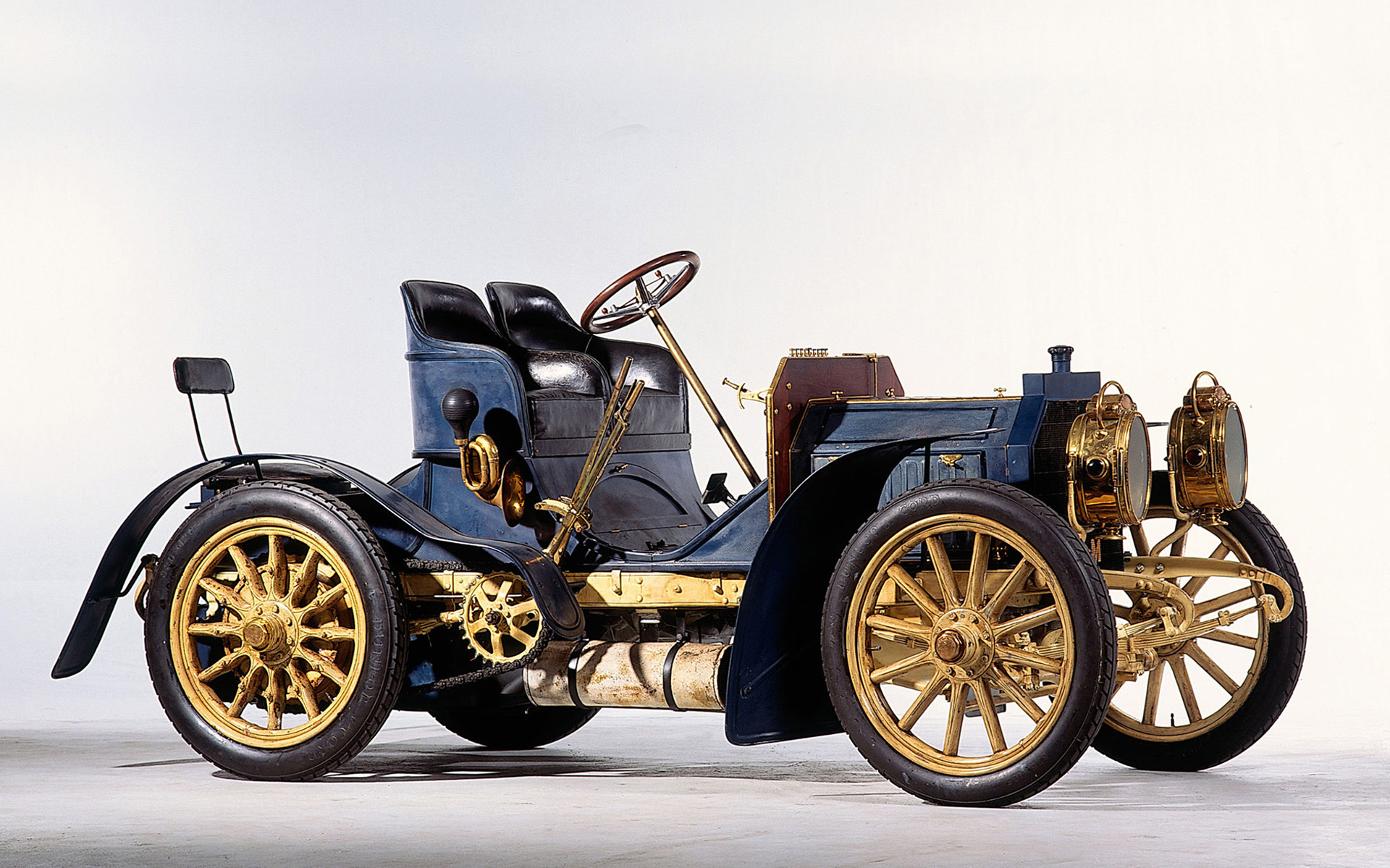
The Mercedes-Benz - 1 The Roarington Digital Twins are realistic digital replicas of classic cars — such as the 1902 Mercedes-Simplex 40 PS — faithful both in appearance and in driving behaviour.
Until now, it would have been unthinkable to imagine being catapulted across such vastly different years, at the wheel of cars equally distant from one another — separated by decades of technical evolution, design philosophy, and entirely different conceptions of what it means to drive. You move from cars that demand essential, almost primitive gestures, yet rich with a certain physical awareness, all the way to machines engineered for maximum precision and absolute performance. Along this journey you encounter some of the most iconic cars in Mercedes-Benz history, protagonists of pivotal moments in motorsport. And so we begin from very far back: at the wheel of the 1902 Mercedes-Simplex, a car that, even at its debut, set breathtaking benchmarks — 111.8 km/h of top speed and a record in the Nice–La Turbie hillclimb.
The Mercedes-Benz - 2 Thanks to the Roarington simulators, it is now possible to relive the emotions of driving cars born more than a century ago, such as the Mercedes-Simplex 40 PS, which was the protagonist of the Nice–La Turbie hillclimb in 1902.
Fifty years later — a new steering wheel, a new language of driving: here we are in the Mercedes-Benz 300 SL "Gullwing", number 417, which made its debut winning the Gran Turismo class at the 1955 Mille Miglia. Faster than many of the Sports cars in the higher category, that car began the glorious story of the most dreamed-about model in the world.
The Mercedes-Benz - 3 At the 1955 Mille Miglia, John Fitch drove his 300 SL number 417 — the number derived from the 4:17 AM departure from Brescia — to fifth place overall, winning the Gran Turismo category.
One step further? Careful — this is no longer a game. Here we find ourselves at the wheel of the Mercedes-Benz 300 SLR "722", the absolute record holder at the 1955 Mille Miglia, with Stirling Moss behind the wheel. To drive it today means confronting an extreme, ferociously fast Sports car, where the margin is razor-thin and every decision must be instantaneous.
The Mercedes-Benz - 4 In the Mercedes-Benz 300 SLR "722", Stirling Moss — accompanied by Denis Jenkinson with his celebrated pace-note system — covered the 1,600 kilometres of the 1955 Mille Miglia in 10 hours, 7 minutes, and 48 seconds, setting a record that has never been broken.
The final leap brings us to the early 1990s with the Mercedes-Benz 190 E 2.5-16 Evolution, winner of the spectacular DTM Championship in 1992 — and here the generational shift becomes definitive. The driving is precise, aggressive, almost surgical: aerodynamics, grip, and outright speed raise the very concept of performance to a completely new dimension.
The Mercedes-Benz - 5 The Mercedes-Benz 190 E 2.5-16 Evolution II DTM was born as the extreme evolution of a compact saloon, transformed into a competition weapon. Its apex came in 1992, when Klaus Ludwig claimed the DTM title at the wheel of the Evo II in a season of total dominance.
All of this — or even just a single experience with a single car — is possible at the Mercedes Museum in Stuttgart, thanks to Roarington. Each driving session costs just 14 euros to board not a mere simulator, but a genuine time machine. Ten minutes per model, accompanied by an instructor who advises on how to interpret each different car and how to understand its reactions.
An experience that places Stuttgart at the very top of every enthusiast's next journey.
The Mercedes-Benz - 6 Bernd Mayländer, Karl Wendlinger, and Bernd Schneider — all former drivers of the Star — have recorded the best times. Now there is nothing left to do but go to the Stuttgart Museum and try to beat them.

Register to unlock this article

Signing up is free and gives you access to hundreds of articles and additional benefits. See what’s included in your free membership. See what's included in your free membership.

Already have an account? Log In