Photo credit: Aguttes, Barrett-Jackson, Broad Arrow, Osenat, WB & Sons
Just before the Pebble Beach sales there are a couple of weeks without auctions – a kind of calm before the storm. We could take a week’s holiday ourselves, or we could discuss at length an auction we didn’t have time to cover. Or we simply enjoy the "what we missed" moment, our opportunity to revisit a few lots that, for various reasons, never received a little ink even though they deserved it entirely.
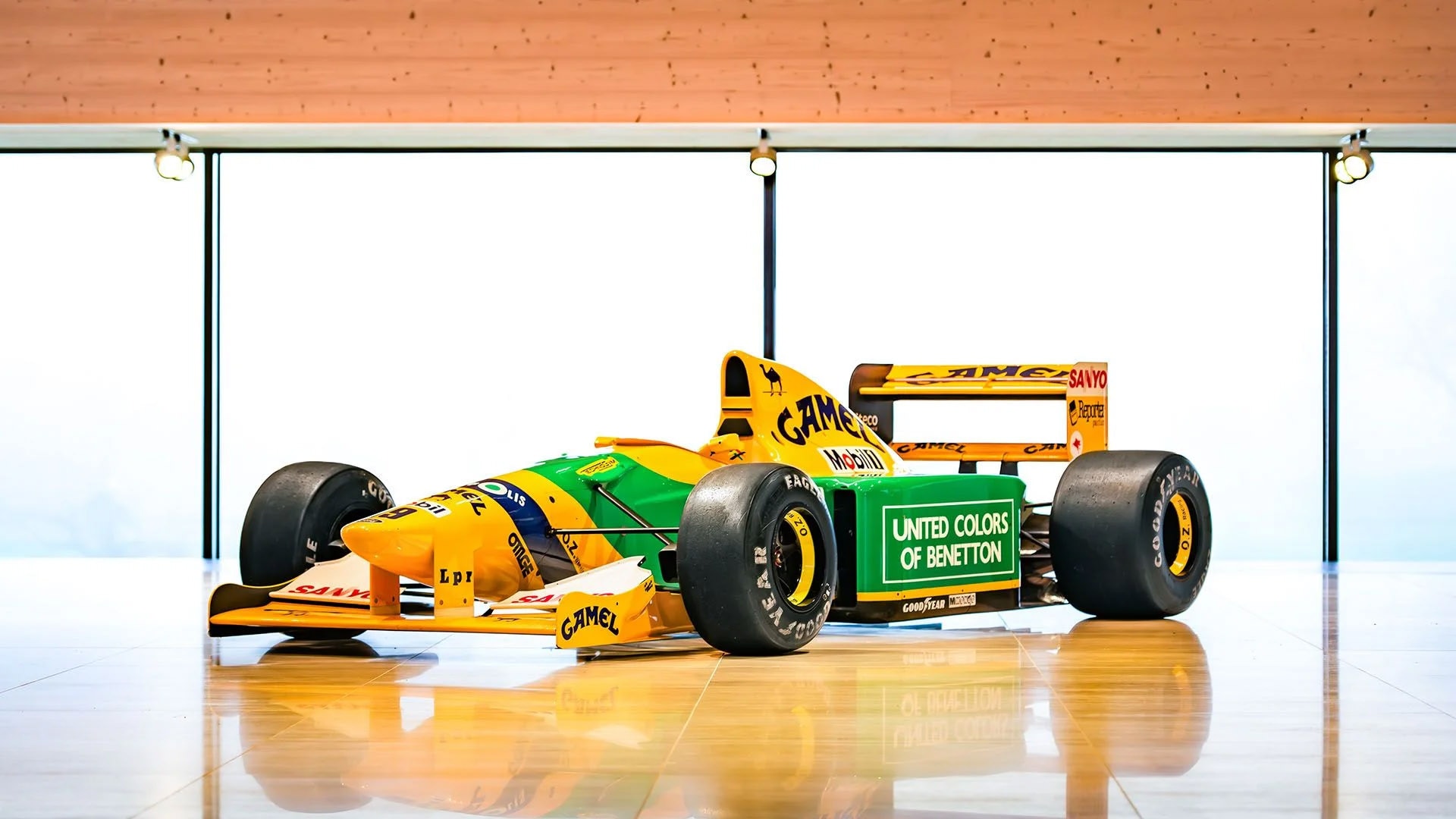
We start in January with Broad Arrow. The Americans at Rétromobile did not organise live bidding – unlike what will happen in 2027 – but they did run an experiment: bringing around seventy cars to display and then accepting bids through their online platform. A hybrid sale that had been tried a few years earlier. And we are not talking about inexpensive cars, but genuine heavyweights of the automotive firmament. Take the top lot, the 1992 Benetton B192 F1. This example was driven by Michael Schumacher, and not in a minor race but at the Belgian Grand Prix, where he claimed the first of his 91 victories in the top formula. It was also used in four other races, including a second-place finish at the Canadian GP, all in the hands of the German standard-bearer. Furthermore, the B192 was the last F1 car with a manual gearbox to win a Formula 1 Grand Prix. After its racing life it was retained by Benetton, which later passed it to the Renault Classic collection – all without it ever appearing in a public sale. Naturally, a car carrying such a weight of history needed no advertising; it sold itself. The estimate was "over €8,500,000" – decidedly ambitious – but the bids were substantial. One can hardly call €5,082,000 pocket change (bearing in mind that the F1 market is a niche, given the difficulty of actually using these cars); perhaps the seller was disappointed, but I believe the price was fair.
Another car from this sale captured my imagination. A 1967 Fiat Dino Spider – not just any Dino, though, but the one that competed in the 1968 24 Heures du Mans. The Dino project was a joint venture between Ferrari (which needed high production numbers to homologate its 2-litre engine) and Fiat (both in view of the subsequent acquisition and because it could exploit the racing aura to "ennoble" its own products). Since the French 24-hour race was the Prancing Horse’s "kingdom", the parent company did everything it could to discourage the cars’ participation – but Fiat-Abarth France was the only team to succeed: the reflected glory of a result in France was too tempting to respect the diktat from Turin. Entered as number 46, it ran a fine race, finishing sixteenth overall. Offered at auction by the owner who had held it for at least three decades, it came with an enormous dossier of documents certifying the car’s provenance. Estimated at €200,000–240,000, it was hammered at €209,000 – a figure I consider a bargain. With a car like this, opportunities are never in short supply.
One did not need to travel far from Paris to find another bargain, this time offered at the end of March. The car is one that is now somewhat out of fashion: a 1934 Delage D8-15L Cabriolet. The eight-cylinder engine of nearly three litres and 80 horsepower was produced for a single year, which makes it rare and desirable. It is also a unique example bodied by Chapron with magnificent style – and we know this because it is Noelle Chapron herself who documented the car’s genesis. We have little information until the late 1990s, when it came into the possession of a collector who sold it in 2019 to the vendor. Adding this car – one that stops everyone in their tracks – to one’s collection in place of the "usual" modern classic would lift any enthusiast above the crowd, with genuine distinction, at a cost of €50,000–80,000. The price of €60,200 is in line with the market, but, as noted, it deserves more.
On the other side of the Atlantic, in April, a piece of motoring history came up for sale. Barrett-Jackson is known for seeking spectacle, and so the Ferrari 308 GTS used in the Magnum P.I. television series was very much in its wheelhouse. The year was 1979; the colour, red over a beige interior; the removable roof, perfect for filming. It was used in the pilot episode and the early instalments of the hugely successful series. Bidders had no trouble with identification: in addition to extensive documentation from multiple sources, there was the telling detail of the modified seat. In an era when Ferraris were built for smaller frames, the "giant" Tom Selleck – standing 1.93 metres tall – was poorly served by the interior. That was the final piece of evidence buyers were looking for, and the bids poured in. The figure paid by the buyer was $379,500 – needless to say, a new record for the model.
Speaking of records, another arresting price was hiding in the same sale. First, one must understand the car: a 1973 Volkswagen Thing Convertible. The official designation is Typ 181, and the commercial name changed from market to market. In the USA it was the Thing; cross the border into Mexico and it became the Safari; in the United Kingdom it was the Trekker; in Italy, the Pescaccia; and in German-speaking countries, the Kurierwagen. These are very common cars – anything but sporting – yet they are among the last production automobiles to combine four doors with a fabric hood. The average price is $5,000–25,000, which makes it remarkable that an example with no particular distinguishing features was hammered at $71,500, setting a new record for the model.
But it was not only the Palm Beach, Florida sale that left Barrett-Jackson experts smiling. At the end of June, the newly organised auction in Columbus, Ohio attracted buyers and – records. Even if it was not the most expensive car in the sale, the 1969 Ford Mustang Boss 429 Fastback made me sit up and take notice. The Candy Apple red paintwork with a black interior was perfect – all the more remarkable given that the car had never been restored. Perhaps it helped that it showed just 4,435 miles. The documentation, too, was substantial: all the original paperwork, the certifications, even letters from former owners explaining to their successors how the Mustang liked to be treated. Only in May a new record for a "Boss" had been set at Mecum’s Indianapolis sale, at $660,000 – I had written about it and wondered what the next edition might bring. The answer came sooner than expected: Barrett-Jackson broke the million-dollar barrier at $1,045,000.
We cross the Atlantic again and arrive in the United Kingdom, with another record. This time it is the small English house WB & Sons – a single location, their own premises, a testament to a network of local clients. If youngtimers are on the rise, hot hatches are taking off alongside them. In fact, it is precisely the smaller local auction houses that can compete in this arena: to sell a £500,000 Ferrari you need an international clientele, but to place an 1980s hot hatch at £20,000 you simply need to find the right buyer within 150 kilometres. Case in point: a 1989 Vauxhall Nova GTE – the Opel Corsa GSI for mainland European readers – in white with a black interior and 94,000 miles. Interesting, too, that it was restored in 2017, about a decade ago (so not fresh off the ramp), at a time when values were still fairly modest. A sign that the motivation behind such a restoration was not pure financial calculation, but rather a question of – love? Estimated at £15,000–20,000, it was hammered at £17,000.
We end where we began: Paris. On 4 May, Aguttes moved from Neuilly – a suburb of the city – to the Grand Palais, which served as the official departure point for the Tour Auto, setting off from that art deco landmark. What better setting in which to offer the 1961 Jaguar MK2 3.8 that had competed in two editions of the original event? Indeed, in 1961 it had won the Tour Auto outright, in the hands of Bernard Consten, before attempting to repeat the feat the following year with less fortune. In between came the Tour de Corse, the Mont Ventoux, and the Rallye des Cévennes. Restored between 2006 and 2017 – with a 29-page invoice – it presented in its competition specification: white with black wheels and sport seats trimmed in red leather. The estimate of €180,000–240,000 was ambitious (given that the price of a standard example sits at around €25,000–45,000), but I am certain that the setting and the emotion played their part: €298,000 is a new world record, four times the previous figure.