Cars and Art: Ilya Avakov, from Russia with Love
20 September 2025 4 min read 4 images
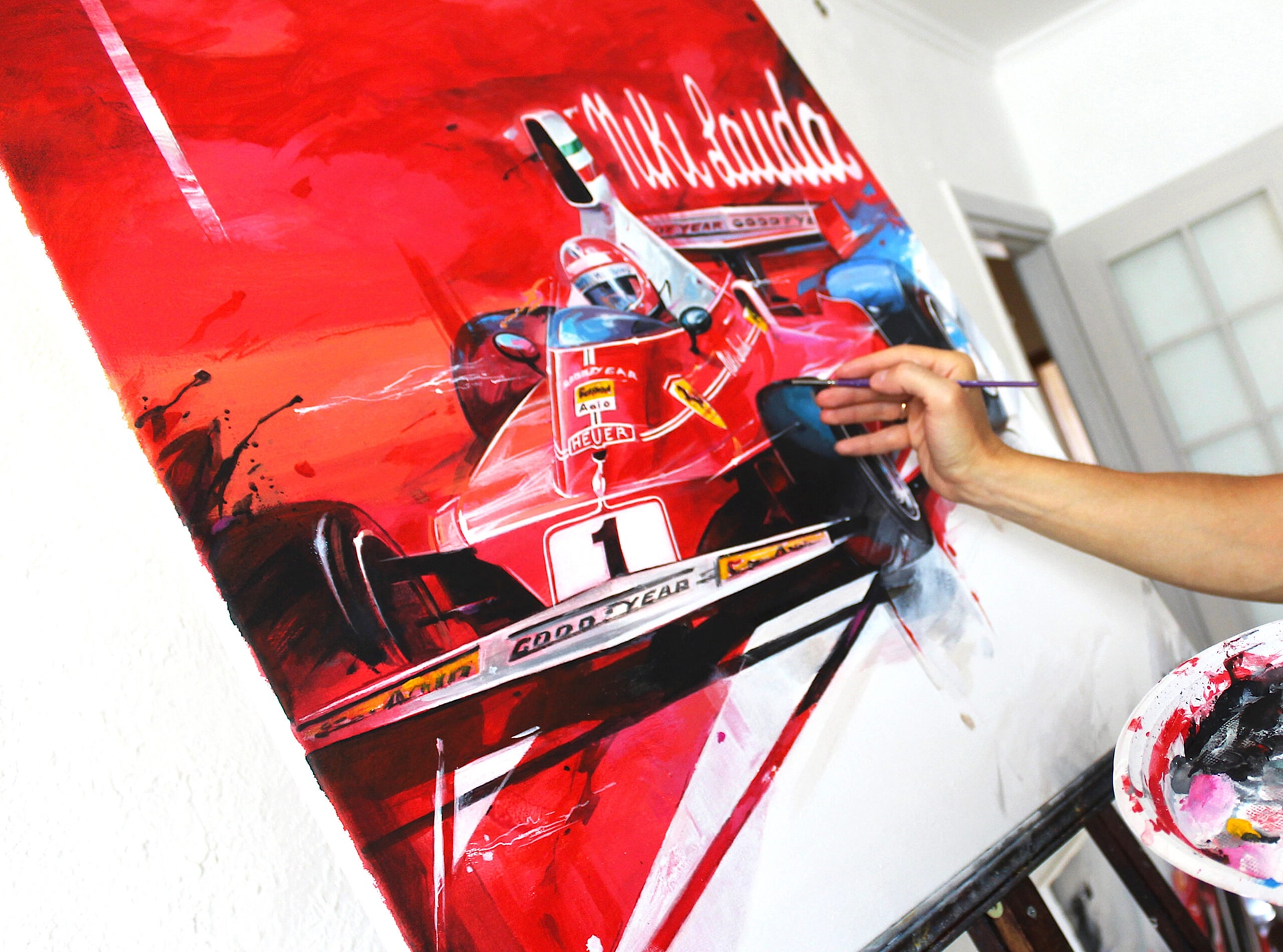
Photo credit: Ilya Avakov
The automobile is born from a drawing, refined and built into reality. In certain cases that reality returns to its origins through painting. Ilya Avakov knows this journey well, because before dedicating himself to automotive art he trained as an industrial designer. His studies at the Stieglitz Academy in St. Petersburg set him on the path toward what is, for him, both a joy and a vocation: interpreting the automobile through a language that moves between realism and expressionism.
In his paintings the precision of the designer remains visible, yet never tips into pure hyperrealism. Avakov studies proportions, light, and perspective with care, and builds his compositions initially through digital tools as well. The paint – oil above all, with brushstrokes left deliberately visible, strong colours, and backgrounds that often seem to dissolve around the car – also recalls the sketches produced in design studios: the machine is precise, while everything surrounding it can become pure atmosphere.

As early as 2017, Avakov had taken his work beyond Russia, participating in the Art of Motoring at the Royal Automobile Club in London. His paintings subsequently appeared at other events dedicated to automotive art, among them Race Retro and, in 2020, the Boca Raton Concours d’Elegance in Florida, where he exhibited with the Automotive Fine Arts Society.
It was there that he also had the opportunity to meet Camilo Pardo – designer of the Ford GT and a painter in his own right – whom Avakov has named as one of the artists most capable of influencing his work.

Ferrari, Lamborghini, Alfa Romeo, Brabham: Avakov chooses predominantly cars that have already entered the collective imagination, yet what he seeks above all is the viewpoint best able to convey their proportions. It is not simply the rare or famous machine that interests him – it is the form.
This is demonstrated, too, by a curious commission that arrived from Italy. A collector asked him to paint his GAZ Volga M21 – a Soviet car acquired after chancing upon an example during a trip to Moldova and subsequently bringing it all the way to Lake Como. A romantic glance at a vanished world.

The relationship between design and art, for that matter, has never left his practice. Avakov looks at a car first through the eyes of a designer and then through those of an artist. He does not simply seek to reproduce it: he seeks the traits of a line, the perspective, or the colour capable of explaining why that form became memorable. For him, a car cannot and must never be still. Its dynamism must endure even when painted on canvas and made the subject of a picture. The car sits motionless on the canvas, yet it often appears to be moving still.