Don’t Dream It. Be Part of It - We are hiring!

View open positions

The "48 Hours of Le Mans Classic" Between Legend and Heritage

  • 11 July 2025
  • 2 min read
  • 4 images
The "48 Hours of Le Mans Classic" Between Legend and Heritage image

Photo credit: Le Mans Classic, Peter Auto

After thirteen biennial editions, the most important European event dedicated to historic competition cars opens a new era, becoming an annual fixture built around a completely revised formula. In even-numbered years, the spotlight will fall on cars from the 1970s through to the early 2000s, as the protagonists of Le Mans Classic Legend, while in odd-numbered years the cars that built the myth of the 24 Heures in its more distant eras – from 1923 through to the 1970s – will take to the track under the name of Le Mans Classic Heritage.

The response from enthusiasts was immediate: for the first Le Mans Classic Legend, no fewer than 160,000 spectators transformed the Circuit de la Sarthe into a grand celebration of the automobile, demonstrating that the memory of motorsport has never felt more alive.
48 hours of Le Mans - 1 The debut of Le Mans Classic Legend was a success: 160,000 enthusiasts filled the Circuit de la Sarthe, celebrating the great history of racing. A first edition that confirms the strength of the event's new annual formula.
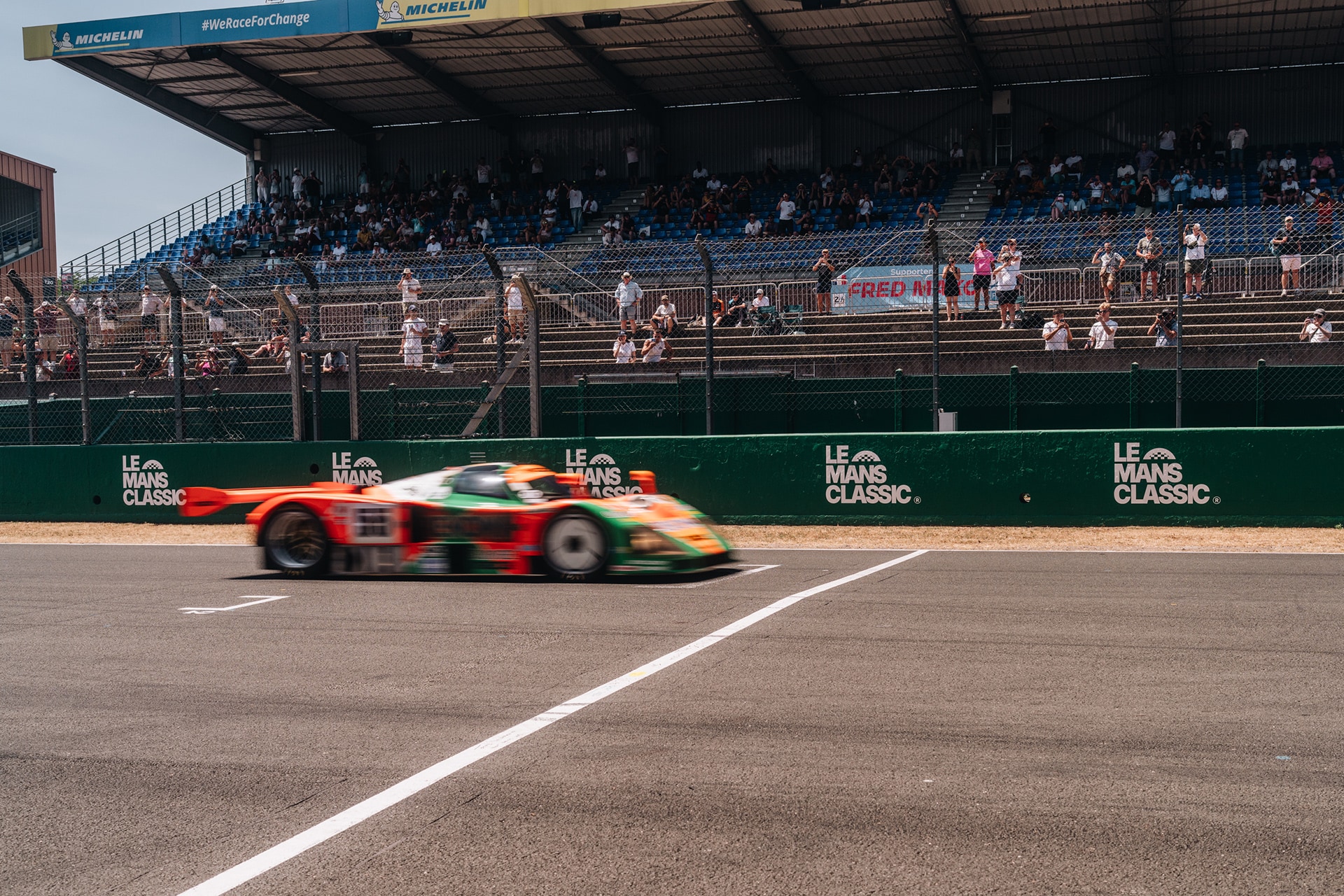
From the very first session on track it was clear that this new formula would work. The categories carried the public on a journey through more than forty years of endurance racing – GT cars, silhouette machines, and the unforgettable Groupe C cars, still capable today of exerting an almost magnetic pull. To see cars such as the Porsche 917 and 962, Peugeot 908, McLaren F1 GTR, and Ferrari 512 BBLM running hard again is to witness the technical evolution of Le Mans compressed into a few kilometres of asphalt, where every surge of acceleration brings to mind victories, defeats, and interminable nights. But if one car proved capable of drawing every eye, it was without question the Mazda 787B. Thirty-five years on from its historic 1991 victory – the first achieved at La Sarthe by a Japanese manufacturer, and the only one in history for a Wankel engine – the legendary number 55 returned to the scene of its masterpiece for a series of dynamic demonstrations. It was not a race, yet hearing that four-rotor engine climb through its rev range was enough to understand why, even today, any search for the 'greatest sound in motorsport history' will inevitably lead back to it.
48 hours of Le Mans - 2 The Mazda 787B provided one of the most moving moments of the event: its legendary four-rotor Wankel engine rang out once more around the Circuit de la Sarthe, thirty-five years after its historic 1991 victory.
The tributes at Le Mans Classic Legend did not stop there. One of the most anticipated guests of the 2026 edition was the singular genius of Gordon Murray, the designer who reshaped both Formula 1 and the supercar. A parade was dedicated to him, bringing together his most iconic creations. On track came the McLaren F1 GTR that won the 24 Heures in 1995, Ayrton Senna's MP4/5B, and through to the modern GMA T.50, T.50s, and T.33 – an ideal bridge between past and present, drawn by the hand of one of the greatest engineers in automotive history. Alongside the track, the paddock and the village areas confirmed their place as the true beating heart of the event. For a happening that runs for 24 hours, night included, the M24 museum kept its doors open until late in the evening, while the Artcurial auction brought some of the most coveted collector cars back under the spotlight – and the hammer. A drive-in cinema celebrated the relationship between film and the automobile with features capable of stirring magnificent memories. The displays dedicated to cars from the silver screen, the arcade zone, the funfair, and the evening concerts all reinforced a philosophy that has, over the years, become the event's defining signature: turning Le Mans into a cultural festival in which the automobile is the common thread, but not the only protagonist.
48 hours of Le Mans - 3 Present and past on the Sarthe starting straight: the Le Mans GTR T56 from GMA's Special Vehicles department pursued by the legendary McLaren F1 GTR Lark, both born from the hand of Gordon Murray and each capable of marking different eras with the same vision.
And the racing? Plentiful and gripping. For the historic cars, the 24 hours are redrawn as a series of races dedicated to cars of the same era, repeating from Saturday afternoon through the night, into the morning, and up to the stroke of 4 p.m. on Sunday – the hour at which, in the real 24 Heures every year, the winner crosses the line. Adding further spectacle to the sporting programme were the Porsche Classic Cup, the GT3 Revival Series, the Berlinette Challenge, and the HSR NASCAR Classic by Goodyear.

And then the Little Big Mans: boys and girls at the wheel of replica racing cars, a reminder that the best way to keep the passion for automotive heritage alive is the ability to move those who discover it for the first time.

With Le Mans Classic Legend now in the books, it is time to mark the calendar for the four magnificent days running from 1 to 4 July 2027, when it will be the turn of Le Mans Classic Heritage – the telling of how the legend began. At Le Mans, even the past cannot stop racing.
48 hours of Le Mans - 4 Passion knows no age: at the Little Big Mans, the classic Le Mans-style running start became the symbol of a new generation's first encounter with the myth of La Sarthe.