Cars and Art: the Surreal Automobiles of Salvador Dalí
11 July 2026 1 min read 3 images
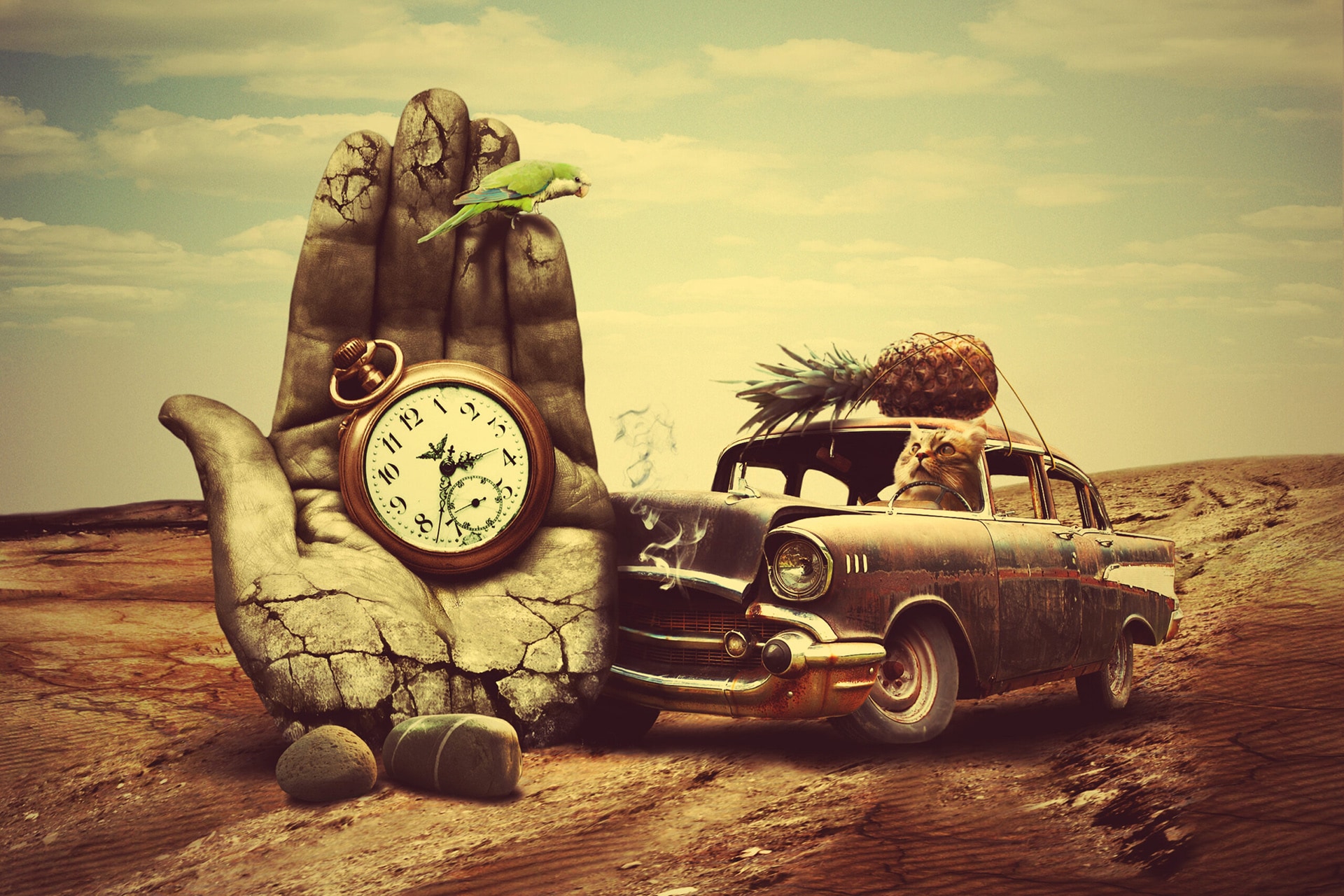
Photo credit: Teatre-Museu Dalí, WikiArt
It is curious that humanity had to wait until 1924, and read André Breton's manifesto on surrealism, to become aware that true surrealism lies within us. What, if not our dreams, recounts situations in which we flee from rationality and logic – precisely what the yellow-paper Manifesto of Surrealism demands?
Perhaps this is why Salvador Dalí's soft watches, the small trains running along the horizon of Giorgio de Chirico's metaphysical worlds, and the jockey spurring his galloping horse across the roof of an old automobile by René Magritte hold such a profound fascination for us.
The spectacular Salvador Dalí, through his performances and his works, thought often about automobiles. Or, more precisely, about what is not quite an automobile. Rightly so – since surrealism must break free from what we are accustomed to seeing and knowing – the automobile covered in grass, carefully watered to preserve its colour and its scent, was a perfect surrealist statement. More than that, the choice of a Volkswagen Maggiolino, a basic expression of a car that is not quite a car in its qualities of charm and expressiveness, was the perfect choice.
There was only one true limitation: the Artist had no driving licence and did not know how to drive. But for him, anything outside the rules was surrealist expression. And his grassy Maggiolino was exactly that.

For Dalí, the automobile nonetheless carried a deeper meaning tied to the futurist movement and to speed: his universe, almost always one of absolute stillness even in potentially dynamic situations, placed the automobile at the far end of the world. A world that had been motionless for centuries, suddenly set in motion. One might say, searching through his thinking, that the automobile was for him a symbol – to the point that he came to dress it elegantly in drapes and velvets, their colours carefully harmonised with the bodywork's finish. For this purpose he chose the luxurious Cadillac he named Gala, which also became the subject of a curious episode that the American manufacturer turned into an advertisement.
After Dalí had created his artwork named Gala, the American marque had launched the Cadillac Gala model, and Dalí, without a moment's hesitation, demanded the considerable sum of $10,000 in the early postwar years – real money, then – for the rights to the name, which Cadillac paid without argument.

Among Dalí's automotive eccentricities was also, in 1938, what he christened the Rainy Taxi. The car, needless to say, offered no shelter from the rain. On the contrary, those on board were drenched by a kind of shower. It was 1938, and this too was a Cadillac. The American manufacturer did not think to demand $10,000 for the damage to its image. How could it? Artists are like that – better to take them as they are.