Cars
Formula 1: The Turbo Revolution and Renault’s Yellow Teapot
How Renault’s turbocharged RS01 revolutionized Formula 1, leading to the extreme 1000+ hp turbo era of the 1980s.
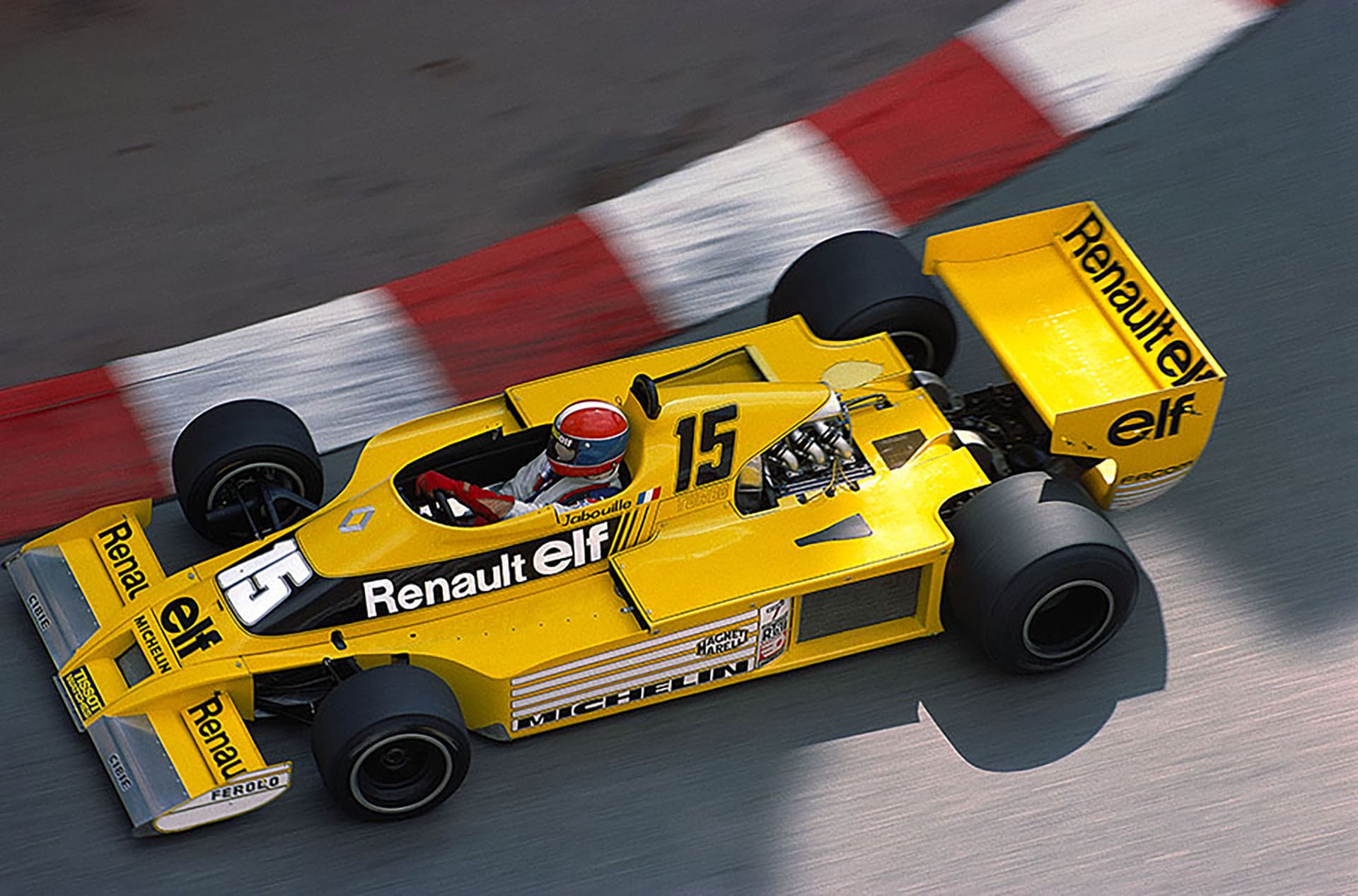
After the successes of the supercharged Alfa Romeo engines that won the World Championships in 1950 and 1951, although the regulations allowed an alternative with naturally aspirated engines, no constructor had attempted that path again. It was only toward the end of the 1970s that a clause in the existing regulations—allowing the use of a 1500 cc supercharged engine as an alternative to the 3000 cc naturally aspirated unit—finally became reality thanks to Renault.
To understand the French manufacturer’s decision to field, in 1977, a single-seater powered by a 1500 cc supercharged engine, one must know that traditional supercharging relied on mechanical compressors driven directly by the internal combustion engine. This meant that a portion of the engine’s own power had to be sacrificed in order to operate the compressor, inevitably reducing the maximum power available.
The Renault RS01 that debuted at Silverstone introduced something different. Instead of a mechanical compressor, it used a system that recovered the wasted energy of the exhaust gases through a turbine. In this way, no power was taken from the engine itself. The exhaust gases spun a turbine which, in turn, drove a twin turbine responsible for compressing fresh air and forcing it into the combustion chamber. Hence the name: Turbo.