Roarington Offers a Place at the Bernina Gran Turismo in St. Moritz
06 September 2025 5 min read 5 images
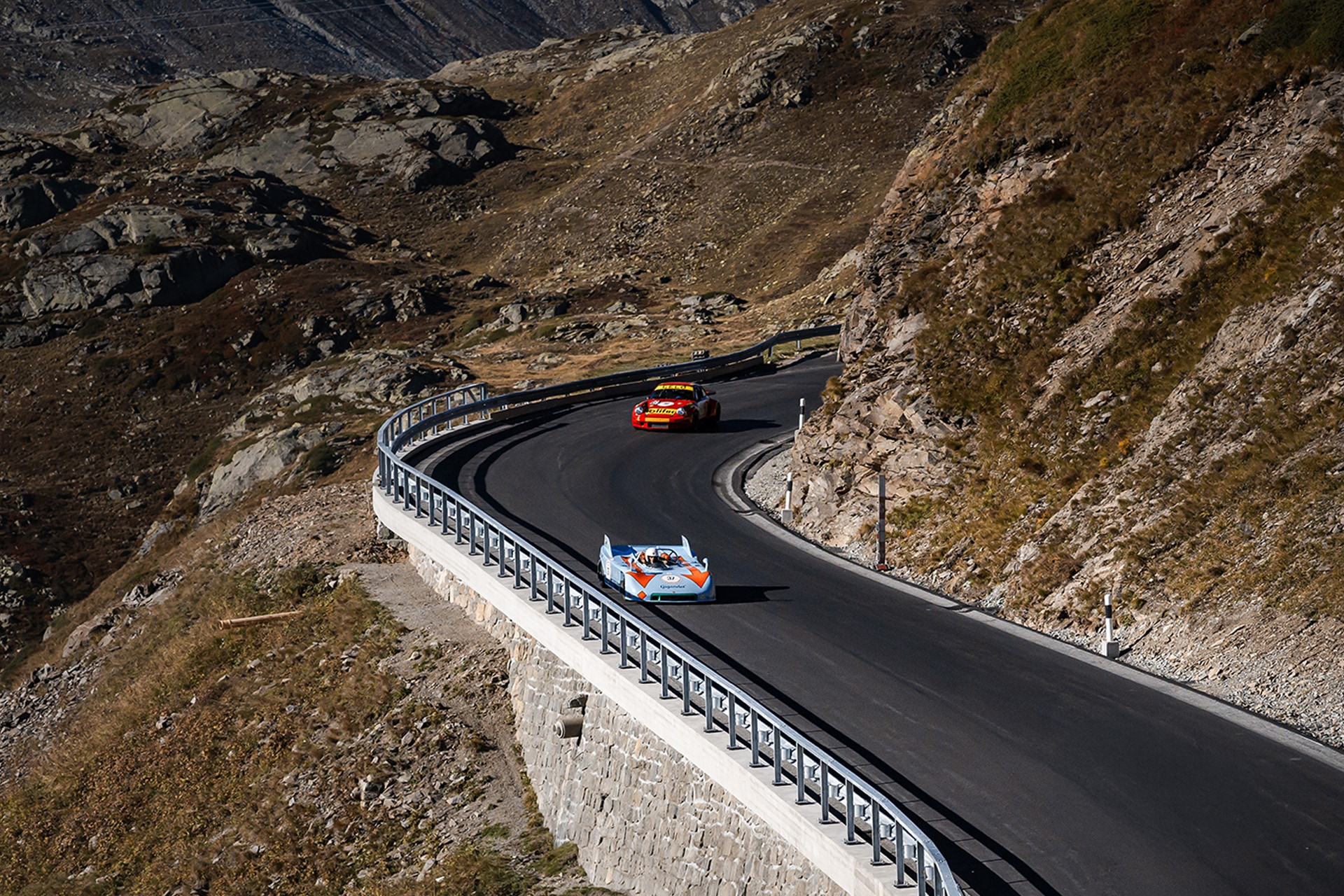
Photo credit: Bernina Gran Turismo
There are fewer and fewer people today who have experienced hill climb racing. Even before the war, these events were an exciting fixture for the many spectators who would position themselves at elevated points along the chosen course, from where they could watch the competitors pass one by one. The format saw the less powerful touring cars start first, followed by progressively faster machinery, culminating with the leading contenders in Sports cars and even Grand Prix single-seaters. In the latter case, given the considerable power of the engines, it was not unusual for twin rear wheels to be used in order to transmit all that horsepower to the road more effectively.

The real explosion in the popularity of these races, however, came after the war, with the spread of the automobile among the general public. There was only one Mille Miglia, and it was an extremely demanding and expensive event, whereas hill climbs were held everywhere, and it was not unusual for two or even three races to take place on the same day. The names of the Mont Ventoux hill climb in France, Sierre-Montana in Switzerland, Freiburg in Germany, and Trento-Bondone and Bologna-Raticosa in Italy have remained famous. Among them, for several years, there was also a fascinating and difficult Alpine hill climb just outside St. Moritz: the first edition, held in 1929, started in Poschiavo and finished at the Bernina Pass, covering an extremely demanding 16 kilometres. Victories by drivers of the calibre of Hans Stuck and Louis Chiron were not enough, however, to ensure the continuity of a race that was considered too dangerous.

With courage and determination, however, the Bernina hill climb returned in 2015. The course was shortened to 5.7 kilometres, but still demands that drivers tackle no fewer than 50 corners over an elevation gain of 450 metres. The 2026 edition will take place from 11 to 13 September, starting from the locality of La Rösa and climbing all the way to the summit at Ospizio Bernina, with two runs on Saturday and one on Sunday. Its official name today is the Bernina Gran Turismo, and one of its distinctive features - also intended to limit practice runs on roads that remain open to traffic - is that, in the days leading up to the event, Roarington Simulators are made available to drivers for training. The virtual course is reproduced with such accuracy that drivers can achieve times equivalent to those recorded in the real race.

On Friday, 11 September, the Roarington Simulator will be available to registered participants, while during the weekend, when the competitors are busy racing, members of the public and enthusiasts visiting the centre of St. Moritz will be able to tackle the hill climb like real racing drivers in two Roarington Simulators. The car chosen for the experience is the Audi Quattro S1, the true beast that became one of the protagonists of the Group B era, offering a driving experience that conveys the fascination of these challenges against the clock. And there is even more at stake: on both Saturday and Sunday, the fastest driver of the day will win an exclusive taxi ride at the Audi ICE experience, courtesy of Audi Switzerland (AMAG).
We look forward to welcoming you to St. Moritz from 11 to 13 September to experience together the spectacle of the 2026 Bernina Gran Turismo.