Cars
Volvo P220 Amazon. When luxury is a station wagon
The Volvo P220 Amazon Station Wagon was introduced in Europe in 1962 and is considered one of Jan Wilsgaard's design masterpieces.

Even today, on many markets, Volvo is mainly associated with station wagons. Certainly, this style of body, which grew in popularity from the 1940s, becoming a fashion icon of the 1960s, owes its success largely to the Swedish car maker. In both America (from the early 1970s) and Europe, Volvo was the manufacturer that first developed the concept of the station wagon as a luxury car, putting paid to the idea that these were purely functional, utilitarian vehicles. Volvo boasts a long history of station wagons, stretching right back to 1947 and the PV 444. These vehicles, albeit initially utilitarian in nature, have in fact been a constant feature of the company’s product range ever since the early postwar years. The P220 Amazon is an evolution of the P120, which was a standard production sedan, first produced in 1957. Five years later, the P220 was unveiled in Europe, showing the world that station wagons can be fast, satisfying to drive, and every bit as comfortable as a sedan, as well as more spacious and practical. The P220 also boasted beautiful interiors and finishing.
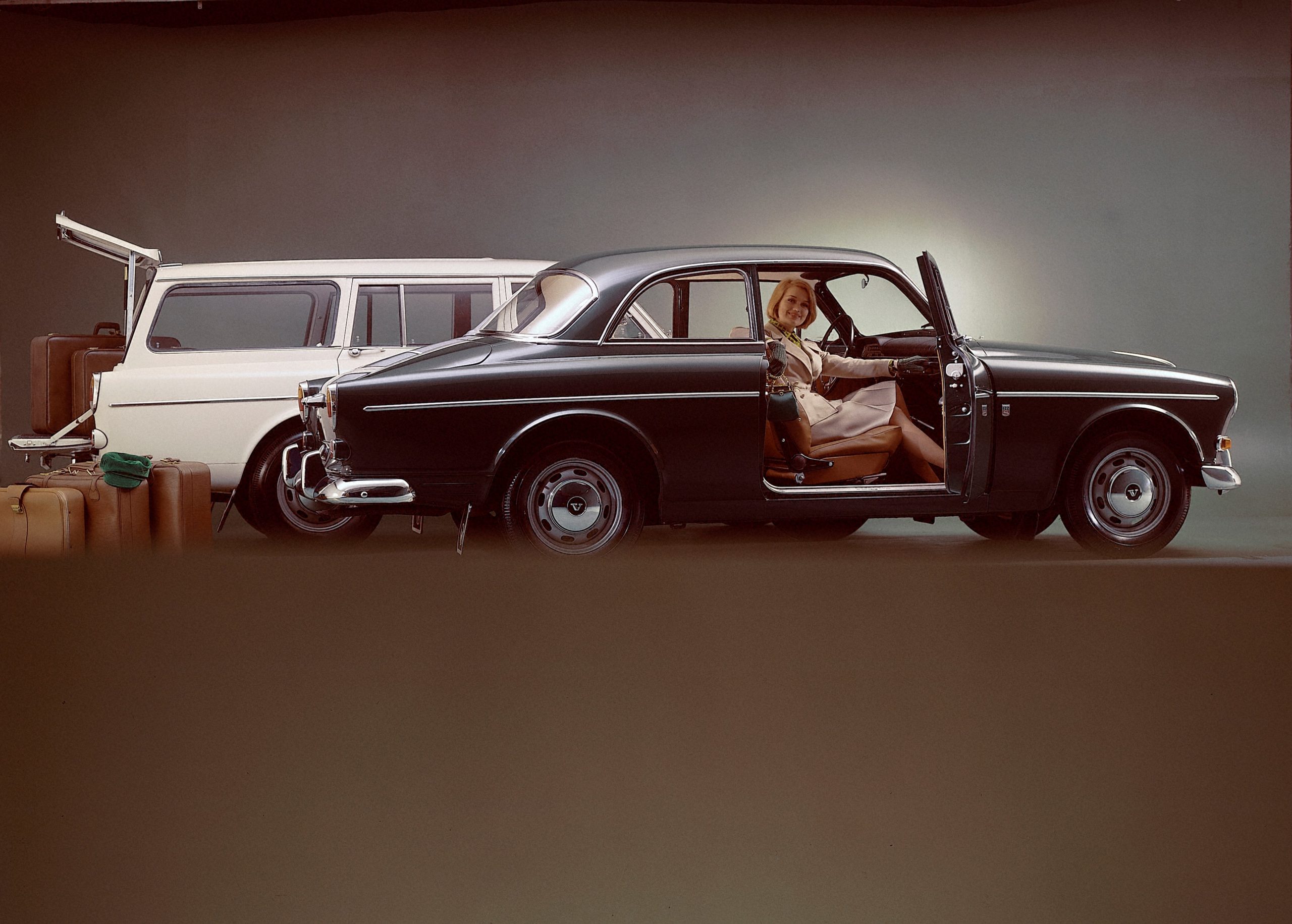 Two of the many faces of the Volvo Amazon: the functional P220 in the background, and the sporty two-door P122 S
Today’s car collectors are now looking beyond sports cars and starting to be drawn to more family-type vehicles. The passion for classic cars is, in fact, far broader than was once realized, and it is widely felt that this should be acknowledged. Accordingly, sedans and station wagons are cropping up more and more at meetings all over the world, where they are welcomed and — this applies especially to the latter —, increasingly admired and coveted. Until now, however, the Amazon has, for some reason, been rather overlooked, with collectors seemingly more interested in the subsequent series, especially the turbocharged six-cylinder models, or in Mercedes Ts (their contemporaries).