Cars
Über Alles. The advent of friendly air
This article discusses the 1939 T80, a car created by the Third Reich to beat the world land speed record by reaching 750 km/h.

January 1940 was meant to see the story of automotive aerodynamics research reaching its pinnacle. The events that we have recounted over 43 chapters, each enhanced by the magical and wonderfully homogeneous illustrations created by Massimo Grandi, tell the story of a time of visionaries and dreamers. The 1939 T80, created at the behest of the Third Reich, and of Hitler in person, in order to give the world a sign of Germany’s supremacy, was built with the aim of beating the world land speed record by reaching 750 km/h. The project involved three key men: driver, Hans Stuck, technical director, Ferdinand Porsche, and aerodynamics specialist, Josef Mikci.
The important aspect, from our perspective, is the technical turning point that this car represented, thanks to Mikci’s development of a down force, designed to prevent the car from taking off at such incredible speed. Never before had a project been based on a design feature that embraced and exploited the air, turning it from an enemy into a friend. Now of course, we know perfectly well from Formula 1 — among other areas, it has to be said — that exploiting the down force allows you to reach exceptional performance levels, even in the presence of a very high CX. For the T80, all this was still too far in the future, and indeed its CX really did seem impossibly low: just 0.18 for a car measuring over 8 meters long and 3.6 m wide (including its lateral stabilizers). But the door to the use of air as a means of increasing ground adherence and transmitting power had finally been opened.
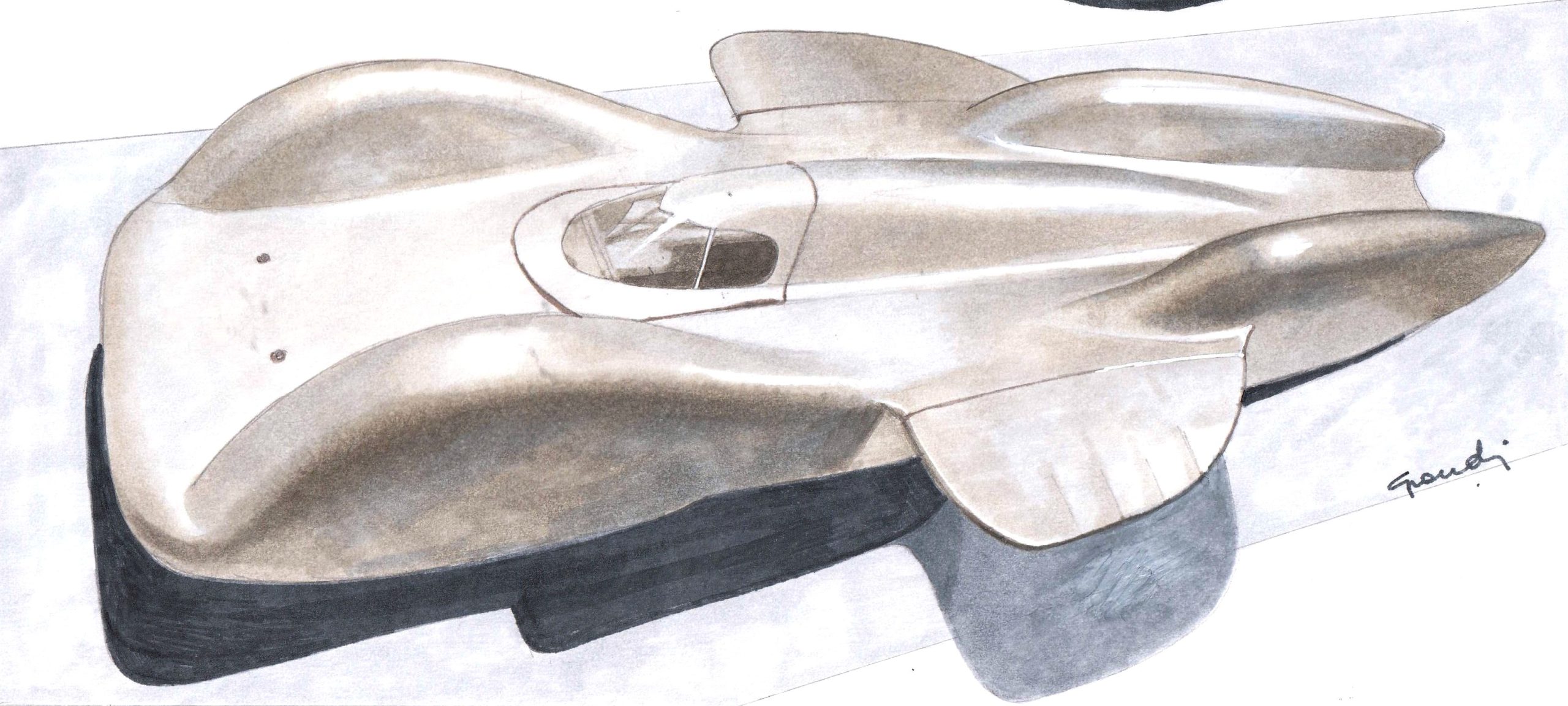 Over 8 meters long and with a CX of just 0.18, the T80 was designed to exploit the down force effect in order to avoid lifting off the ground when travelling at top speed.