Cars
The efficiency of beauty
The Jaguar D-Type is a historic racing car that was designed to be suitable for both the track and the road. The car was created by William Lyons, the founder of Jaguar, and his team of technicians and test drivers.

The Jaguar D-Type has many reasons to be the first of the great sports racing cars (as they called the two-seater roadsters in those years) of our collection of racing cars that made history. The first reason is indeed the very concept of the racing car: not a single-seater vehicle built to race in Grand Prix, but a car designed for the track but also suitable for the road in those years when races were also held far away from the circuits, as was the case of the Mille Miglia, Targa Florio and Carrera Panamericana.
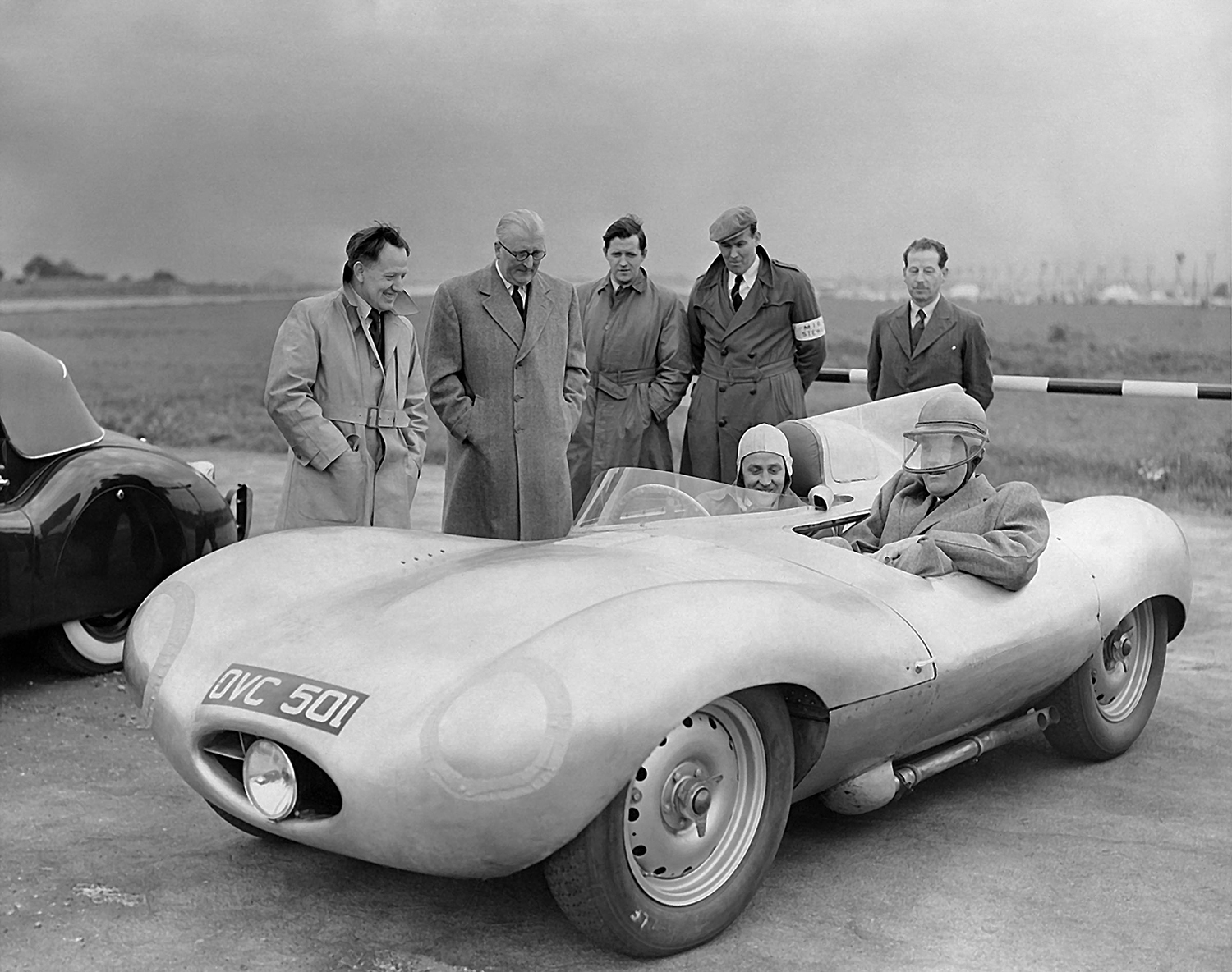 Sir William Lyons sitting bravely next to test driver Norman Dewis for the test of the first D-Type (short-nose) in 1954.
The success of William Lyons’ cars, a sort of British Enzo Ferrari who had “tasted” the world of high-performance cars before the war but created “his” Jaguar only after the conflict ended, was the result of his profound mechanical expertise and his vision and talent in the design of the bodywork. Two victories at the 24 Hours of Le Mans with the Model C, with its excellent mechanics but conventional chassis and style, prompted him to “invent” the so-called English racing car. That is to say, the pursuit of the finest components for each part of the vehicle to compensate for possible weaknesses in the quality of the whole. And the weaknesses of the C-Type were in the chassis and in the aerodynamics.