Cars
Noble Sisters: Renault Clio Williams
The Renault Clio Williams, born from the Renault-Williams F1 partnership, became a cult icon with 12,000 units produced between 1993-1996. Known for its striking design and stellar performance, it now commands high collector value, often exceeding €50,000.

The Renault engine on the Williams Formula 1 car marked a highly effective collaboration between the two companies from 1989 to 1997, achieving four Drivers' Titles, five Constructors' Championships, and 63 Formula 1 victories. One of the most iconic images of this partnership is undoubtedly the domination of the 1992 season by the FW14B, a car designed by Adrian Newey and equipped with the naturally aspirated 3493cc Renault V10 engine. Winning 10 of the 16 scheduled races, it allowed Nigel Mansell to clinch the Drivers' World Championship as early as the Hungarian Grand Prix mid-season. This was the first of four Drivers' Titles in the partnership, followed by victories in 1993 (Alain Prost), 1996 (Damon Hill), and 1997 (Jacques Villeneuve), along with five Constructors' Titles (1992, 1993, 1994, 1996, and 1997). Outside Formula 1, Williams and Renault also collaborated on a touring car project, developing the Renault Laguna for the British Touring Car Championship (BTCC). Once again, success was not long in coming: in 1997, it won all three BTCC trophies – Drivers', Constructors', and Teams'.
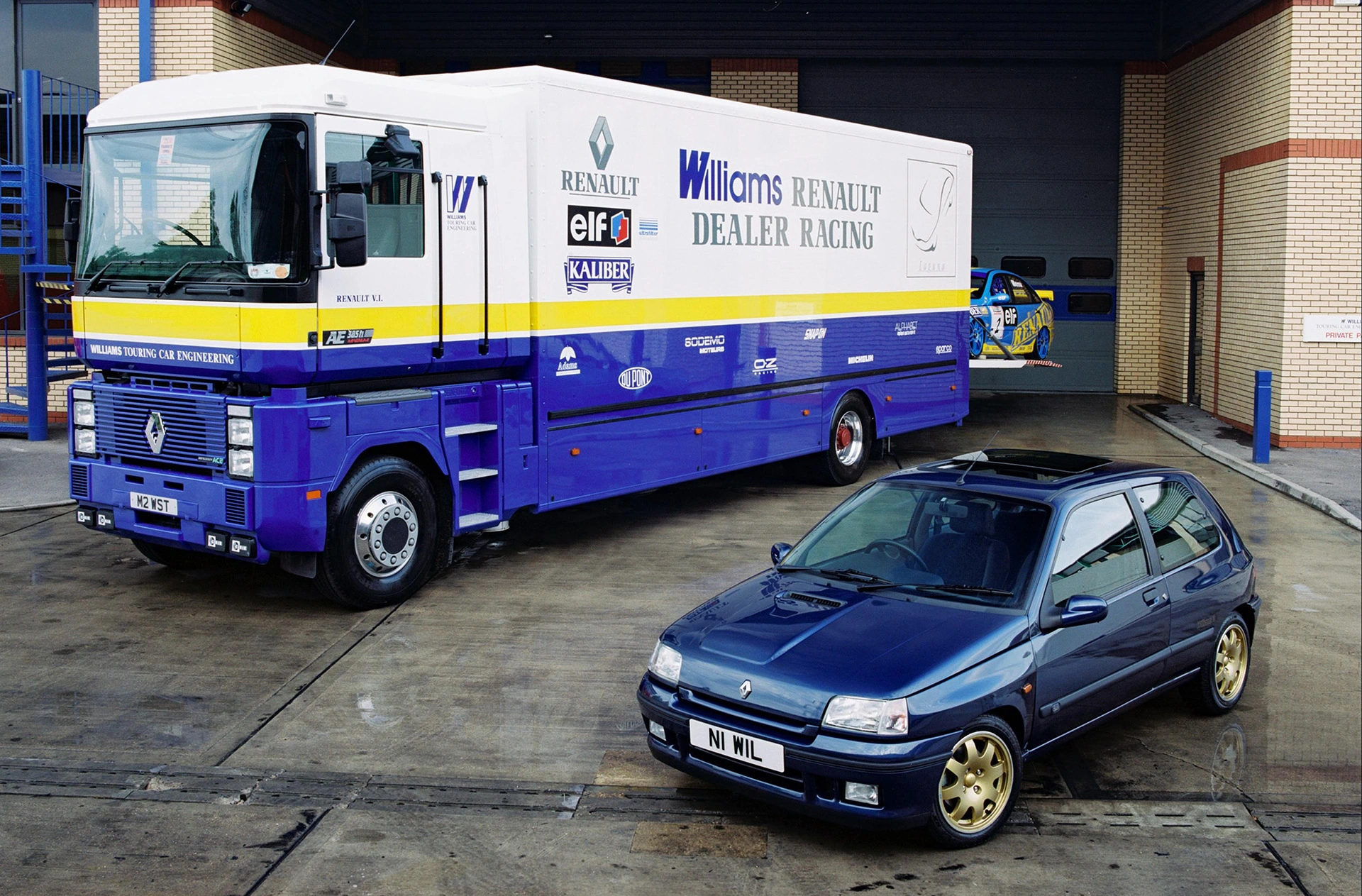
This success gave Renault the marketing and commercial opportunity to develop a road model linked to its track achievements. In 1990, Renault launched the Clio, the successor to the bestselling 5/Supercinq, with a sporty 1.8 16V engine producing 135 hp. The sales success in the first two years on the market encouraged Renault to design an even more extreme version for rallying in Group A and Group N categories.