Cars
Magnificent and challenging
This article examines the historical significance of the Maserati 450S, a powerful car that revolutionized the European racing landscape in the 1950s. The 450S was designed to compete with Ferrari, its great rival.

Enzo Ferrari was not at all amused when Maserati fans once parked a cartload of fodder in front of the Scuderia headquarters in Viale Trento Trieste, with a sign saying: the “Cavallino” (horse) is weak, give it some food! In the 1950s, Maserati was Ferrari’s great rival. Indeed, in that period, Maserati played a part in Fangio’s 1954 World Drivers' Championship victory, and then went on to take the 1957 title with the same driver. Back then, of course, road racing was hugely popular, and Maserati, technologically avant-garde and fielding its Sport models — the 200S (2000cc) and 300S (3000cc) —, enjoyed considerable success. What is more, even though Ferrari was by this time producing its cars at Maranello, the Viale Trento Trieste site, still the historic headquarters of this famous brand, was situated just a few minutes’ walk away from Via Ciro Menotti, where Maserati had (and indeed still has) its headquarters and production facilities.
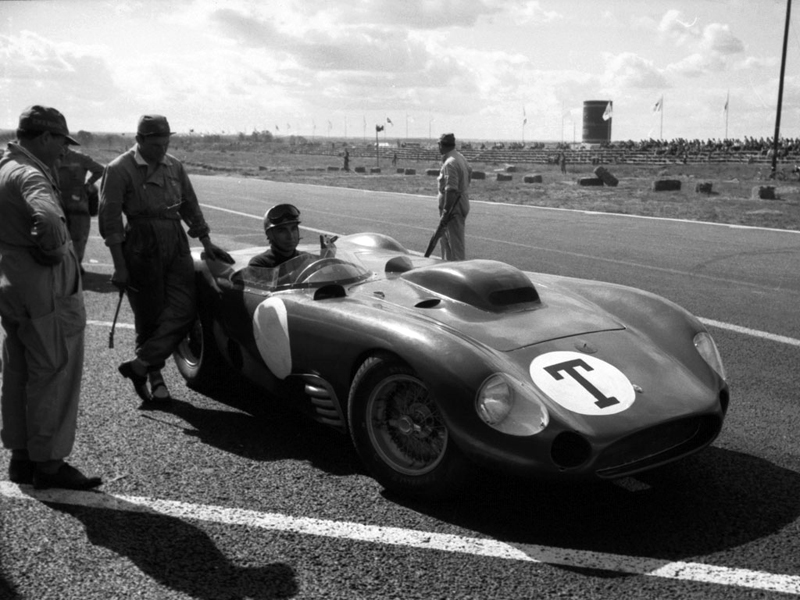 A false start: the first Maserati 450, created by adapting the chassis of the 300S to accommodate the 450’s large V8— note the bump on the hood for the air intake— was structurally inadequate for outputs of over 400 HP. The car appeared on the track at Anderstorp, in Sweden, but did not race.
This background serves to underline the significance of the birth of certain vehicles, in this case the Maserati 450S, which was produced from 1956 to 1958. But first, another premise: the 450S was a truly magnificent car, a bold evolution of the equally beautiful, but less hefty, 300S. The latter stood out for its excellent weight distribution, which was achieved thanks to its rear-mounted axle transmission (transaxle) with gearbox/differential unit, and its drive shaft, which was positioned next to the driver in order to move backwards, and lower, the center of gravity. All this, and an excellent 6-cylinder in-line engine, was combined with a very low weight thanks to the trellis chassis construction and Fantuzzi aluminum body.