Cars
Zonda, the first time of a winning wind
The article discusses the history of Pagani Automobili and its founder Horacio Pagani, who started out in Lamborghini's Composite Materials department and went on to found Pagani Composite Research and Modena Design.

To fully understand the genius of Horacio Pagani, an Argentinian who resettled in the Italian Motor Valley, you need to go way back to 1986 during his time as head of the Composite Materials department in Lamborghini, where he conceived the prototype of the first road car made entirely from carbon fibre: the Countach Evolution. But Oracio had other things in mind: in the early 1990s he founded Pagani Composite Research and Modena Design, where he developed cutting-edge materials for manufacturers such as Renault, Daihatsu, Ferrari, Aprilia and Dallara. Nevertheless, Horacio Pagani had a second job at night, something that was more than a dream: the project with the acronym C8, which would very soon be nicknamed “Fangio F1”, in honour of his great friend Juan Manuel Fangio. A life-changing friend: the Argentine legend who managed to claim no fewer than five Formula One world championships, introduced Horacio to the board of Mercedes-AMG, paving the way for the supply of engines needed for the cars he had planned to build. In 1998 the final prototype of the C8 project was made, which was visually inspired by the “Silver Arrows”, those of Fangio's era that ran in the Sport category.
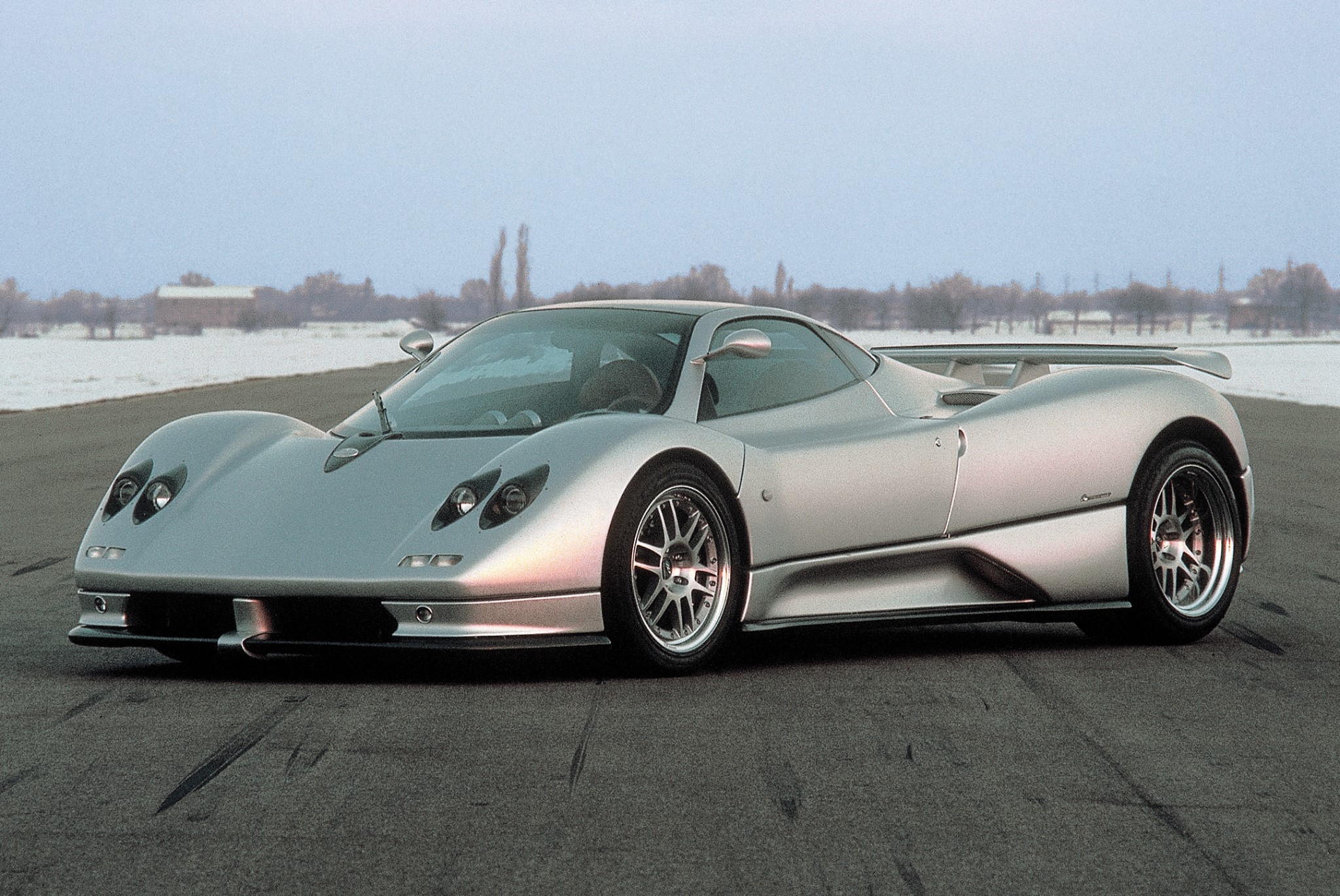 Entirely made of composite fibres, the car has a fluid, highly-personalized line
The following year, the C8 was presented at the Geneva Motor Show under the final name of Zonda, a wind blowing in the Argentine pampas. The C12, this was its acronym, was characterized by the extensive use of composite materials for both the chassis and the body to ensure rigidity and lightness to. Equipped with the Mercedes-Benz M120 6-litre, V12 engine producing 394Bhp and 550Nm of torque, the C12 was capable of reaching over 330 Km/h and register a 0-100 km/h acceleration time of just over 4 seconds.