Cars
Applying intelligence to invention
The article discusses the innovative work of Czechoslovakian car maker Tatra, particularly the contributions of engineer Hans Ledwinka and streamlining theoretician Paul Jaray.

The Czechoslovakian car maker Tatra was the first in the world to make aerodynamic lines its hallmark. But it would be a big mistake to focus only on this aspect of the work of the company’s true architect, engineer Hans Ledwinka. He, a natural innovator, chose to be flanked by the brilliant streamlining theoretician Paul Jaray. In his role as technical director, Ledwinka built on Jaray’s earliest experiments, such as the 1932 prototype T51, in order to rationalize and modernize the cars built by the firm: having already adopted brakes on all four wheels, he introduced the rear-mounted engine, positioned behind the rear axle, which allowed him to lower the floor, thereby creating more space for the vehicle’s occupants.
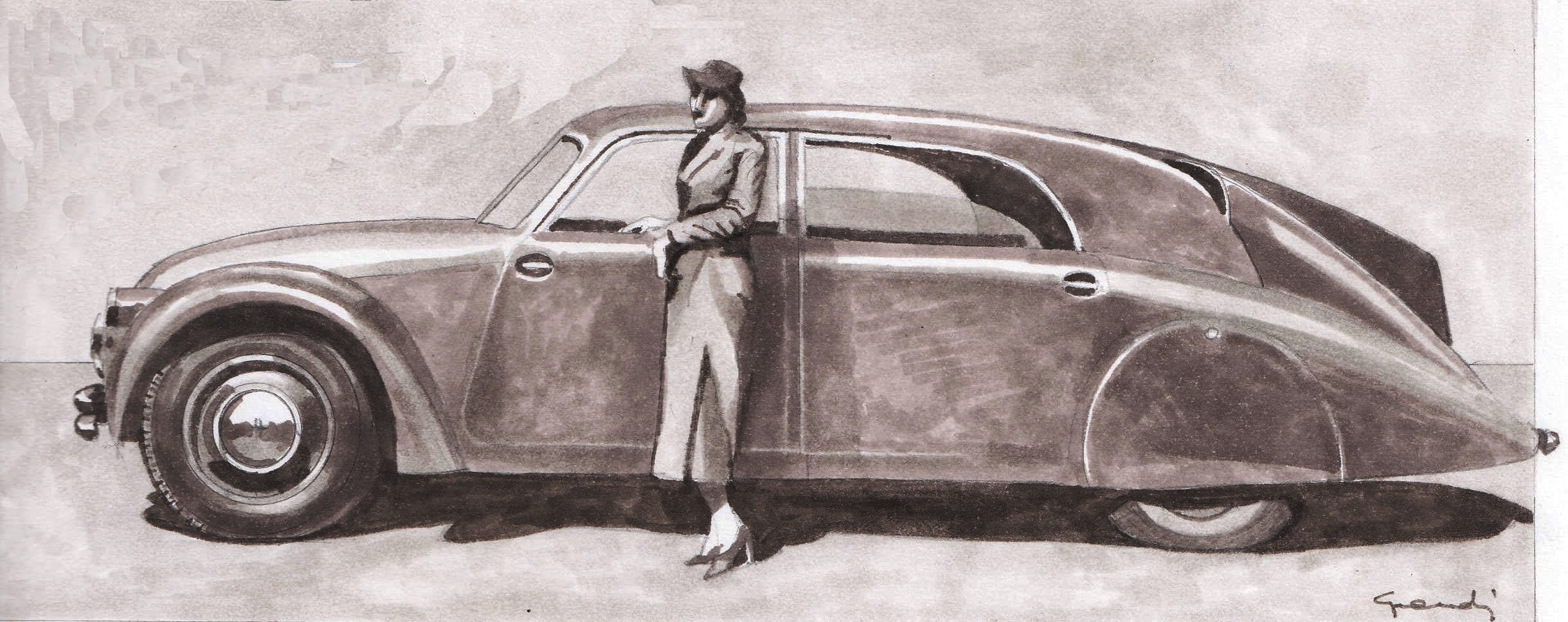 Just a year after unveiling the T77, Tatra, to strengthen its position at the high end of the market, presented the 77A with a bigger (3.4L) air-cooled V8 engine. The car also featured numerous esthetic evolutions.
This solution also allowed him to eliminate the clumsy footboards that were a common feature at the time. The idea of a rear-mounted, air-cooled engine simplified the entire construction and served to distance the car’s occupants from the source of its noise. On the T77A, Ledwinka also introduced three front seats, with the driver in the middle (does anyone remember the McLaren F1 that came 60 years later?), and, in addition to the two lateral headlights, a central one connected to the steering wheel, whose beam followed the direction of the bend (an “invention” widely promoted by Citroën 30 years later, with the “directional headlights” on its DS 21).